
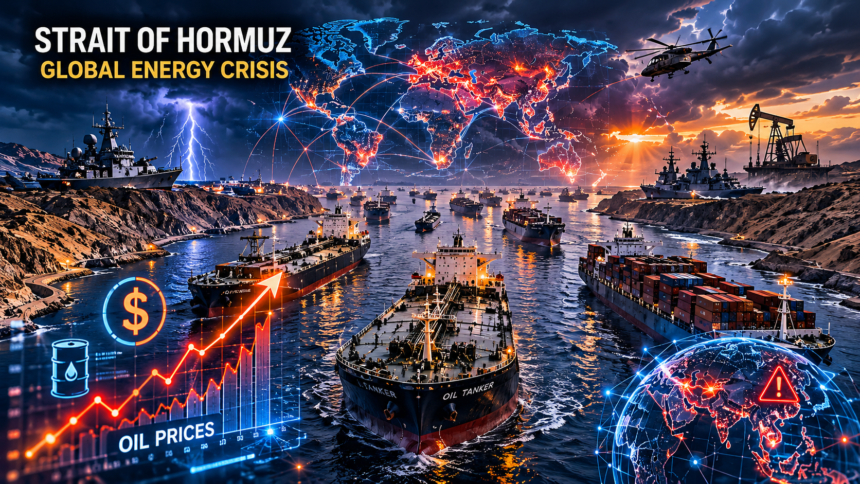
The Strait of Hormuz stands as one of the most important shipping routes in the world. This narrow waterway connects the Persian Gulf with the Arabian Sea and carries a large share of global oil exports every day. Many countries depend on this route for energy supplies, trade stability, and economic growth. Any long-term disruption in this region can create serious challenges for global markets and everyday consumers.
Today, experts, governments, and businesses ask one critical question: “What if disruption in Strait of Hormuz never ends?” The answer affects oil prices, transportation, inflation, food supply chains, and international politics. A permanent disruption would not only damage energy markets but also change the structure of global trade.
This article explains the economic, political, and social impact of a never-ending crisis in the Strait of Hormuz. It also explores how industries, governments, and consumers may respond if this major trade route remains unstable for years.
Why the Strait of Hormuz Matters
The Strait of Hormuz plays a central role in global energy transportation. Around one-fifth of the world’s oil supply passes through this narrow route every day. Major oil-producing countries such as Saudi Arabia, Iraq, Kuwait, the United Arab Emirates, and Iran use this waterway to export crude oil and natural gas to international markets.Asian economies like China, India, Japan, and South Korea rely heavily on oil shipments from this region. European countries also depend on stable energy supplies that move through the strait. Because of this dependence, any disruption quickly affects global fuel prices and market confidence.
The global economy functions through connected supply chains. When energy transportation slows down, production costs rise in manufacturing, aviation, logistics, agriculture, and shipping sectors. This creates a chain reaction across international markets.
Rising Oil Prices and Global Inflation
One of the first effects of a permanent disruption would appear in oil prices. If tankers cannot move safely through the Strait of Hormuz, global oil supply would shrink. Reduced supply usually pushes prices higher.High oil prices affect almost every industry. Transportation companies would spend more on fuel. Airlines would increase ticket prices. Manufacturers would face higher production costs. Shipping companies would charge more for international cargo movement.As business costs rise, consumers would pay more for goods and services. Food prices could increase because agriculture depends on fuel for transportation and machinery. Inflation would become a long-term problem for many countries.
Central banks may respond by increasing interest rates to control inflation. However, higher rates can slow economic growth and increase unemployment. This situation would create pressure on both governments and households.The question “What if disruption in Strait of Hormuz never ends?” becomes more serious when global inflation enters a prolonged phase. Developing economies would face the greatest challenges because they often rely on imported fuel and limited financial reserves.
Impact on Global Trade
Global trade depends on stable shipping routes. The Strait of Hormuz supports not only oil transportation but also regional commercial trade. A permanent disruption would force shipping companies to use longer and more expensive routes.Longer shipping times increase delivery costs and reduce supply chain efficiency. Businesses that rely on just-in-time manufacturing systems may face delays and shortages. Industries such as electronics, automotive production, chemicals, and construction could suffer major losses.
Small businesses may struggle to survive because rising transportation costs reduce profit margins. Consumers would also notice fewer product choices and higher retail prices.International trade agreements may also change. Countries could start building new partnerships to reduce dependence on Middle Eastern energy routes. This shift may reshape global economic alliances over time.
Pressure on Energy-Dependent Countries
Countries that import large amounts of oil would face serious economic pressure. Asian nations would likely experience major energy security concerns because they import significant oil volumes through the Strait of Hormuz.Governments may need to use strategic oil reserves to stabilize domestic fuel markets. However, these reserves cannot support national demand forever. Long-term disruption would force countries to search for alternative energy suppliers.
Some nations may increase investments in renewable energy projects such as solar, wind, and nuclear power. Others may strengthen energy partnerships with countries outside the Gulf region.Energy shortages could also create political pressure inside many countries. Citizens often react strongly to rising fuel and electricity costs. Governments may face protests, economic dissatisfaction, and declining public trust.
Effects on the Shipping Industry
Shipping companies would face higher operational risks if disruption continues permanently. Insurance premiums for vessels traveling near the Strait of Hormuz would increase sharply. Some companies may completely avoid the region due to safety concerns.Freight rates would rise because businesses would need alternative shipping routes. Delays at ports and congestion in other maritime channels could become common problems.
The shipping industry may invest more in route diversification and advanced security systems. Companies could also shift focus toward regional trade networks to reduce dependence on unstable global routes.This situation would increase operational costs across international logistics markets. Consumers would eventually absorb these costs through higher product prices.
Changes in Global Energy Strategy
A never-ending disruption would accelerate the global transition toward energy diversification. Governments and corporations would increase investments in renewable energy infrastructure.Solar and wind energy projects could receive greater policy support and funding. Electric vehicle adoption may also rise faster because countries would seek alternatives to expensive oil imports.Oil-importing countries may focus on building stronger domestic energy systems. They may also invest in energy storage technologies and alternative pipelines that bypass risky maritime routes.
At the same time, oil-producing nations may experience revenue declines if exports become difficult. This could weaken economic growth in Gulf economies and increase regional instability.The phrase “What if disruption in Strait of Hormuz never ends?” now represents more than a regional issue. It reflects a major turning point for global energy policy and economic planning.
Geopolitical Tensions and Security Risks
The Strait of Hormuz has always carried geopolitical importance. A permanent disruption would likely increase tensions between major global powers.Countries that depend on Gulf oil may expand military presence in nearby waters to protect shipping lanes. International alliances could shift as nations compete for energy security and strategic influence.Regional conflicts may also intensify if economic pressure grows inside oil-producing states. Diplomatic negotiations would become more complex because energy security directly affects national stability.
Cybersecurity risks could rise as energy infrastructure becomes a target for political or economic attacks. Governments may increase defense spending to secure supply chains and transportation networks.This environment could create long-term uncertainty in global financial markets. Investors usually avoid unstable regions, and reduced confidence can weaken economic growth worldwide.
Impact on Developing Economies
Developing countries would suffer the most from long-term disruption in the Strait of Hormuz. Many low-income nations already struggle with inflation, debt, and limited energy resources.Higher oil prices would increase transportation and electricity costs. Food imports would become more expensive. Governments may need to increase fuel subsidies, which can create additional financial pressure.Economic instability could also increase poverty levels. Small industries and local businesses often cannot absorb rising operational costs for long periods.
International financial institutions may need to support vulnerable economies through loans and emergency assistance programs. However, long-term economic stress could still slow development goals across many regions.
Opportunities for Alternative Trade Routes
A permanent crisis in the Strait of Hormuz would encourage investment in alternative trade and energy routes. Countries may develop new pipelines that bypass the Gulf region.Railway and land transportation projects could gain importance in Asia and the Middle East. Maritime trade through other channels may also increase.Governments may invest in infrastructure projects that reduce dependence on single shipping routes. These projects could improve regional cooperation and create new economic opportunities.However, developing alternative systems takes time and massive financial investment. The global economy would still face years of adjustment before achieving stable supply networks.
Impact on Consumers Around the World
Ordinary consumers would feel the effects of a permanent disruption in daily life. Fuel prices would rise at gas stations. Air travel would become more expensive. Grocery bills could increase because transportation costs affect food supply chains.Electricity prices may also rise in countries that depend on imported energy resources. Inflation would reduce household purchasing power and increase financial stress for families.People may change spending habits due to economic uncertainty. Demand for fuel-efficient vehicles and renewable energy products could grow rapidly.Businesses may also reduce hiring during economic slowdowns. This could increase unemployment rates in many sectors connected to transportation and manufacturing.
The Role of Renewable Energy
Renewable energy would become more important if disruption in the Strait of Hormuz continues permanently. Governments would likely accelerate clean energy goals to reduce oil dependence.Solar and wind power projects could expand across Europe, Asia, and North America. Battery storage systems may also improve because stable energy supply would become a national priority.Electric transportation systems could receive greater public and private investment. Countries may introduce policies that encourage energy efficiency and local power generation.Although renewable energy cannot fully replace oil immediately, long-term disruption would push global economies toward faster energy transformation.
Financial Market Reactions
Financial markets react quickly to geopolitical uncertainty. A never-ending disruption in the Strait of Hormuz would likely increase volatility in oil, currency, and stock markets.Energy companies may see temporary profit growth due to higher oil prices. However, industries that depend heavily on transportation and manufacturing could experience declining performance.Investors may move toward safer assets such as gold or government bonds during periods of uncertainty. Currency values in oil-importing countries may weaken due to rising import costs.Banks and financial institutions would monitor inflation, interest rates, and supply chain disruptions closely. Long-term instability could reduce investor confidence in global markets.
Can the Global Economy Adapt?
The global economy has adapted to many crises in the past, including wars, pandemics, and financial recessions. However, a permanent disruption in the Strait of Hormuz would create one of the most difficult energy challenges in modern history.Countries would likely develop alternative energy systems and trade routes over time. Businesses may redesign supply chains to improve resilience. Technological innovation could also reduce dependence on traditional oil markets.
Still, adaptation would require years of investment, policy reforms, and international cooperation. Economic pain would likely continue during the transition period.The key challenge would involve balancing energy security, economic growth, and geopolitical stability at the same time.
Future Outlook
The future of global energy markets depends heavily on stability in critical trade routes like the Strait of Hormuz. If disruption continues indefinitely, governments and industries will need to rethink traditional economic models.Energy diversification, infrastructure investment, and international cooperation will become more important than ever. Countries that prepare early may reduce economic risks more effectively.At the same time, global consumers may experience lasting changes in fuel costs, transportation systems, and product pricing. Economic resilience will become a major priority for both developed and developing nations.The discussion around “What if disruption in Strait of Hormuz never ends?” highlights the importance of secure energy systems in a connected global economy.
FAQs
Why is the Strait of Hormuz important for global trade?
The Strait of Hormuz handles a large share of the world’s oil exports. Many countries depend on this route for energy imports and stable trade operations.
What happens if the Strait of Hormuz closes permanently?
A permanent closure could increase oil prices, disrupt global trade, raise inflation, and slow economic growth worldwide.
Which countries would suffer the most from disruption in the Strait of Hormuz?
Oil-importing countries in Asia and developing economies would likely face the biggest economic challenges due to energy dependence.
Can renewable energy reduce the impact of Strait of Hormuz disruption?
Yes. Renewable energy can reduce dependence on imported oil and improve long-term energy security for many countries.
How would consumers feel the impact of this disruption?
Consumers may face higher fuel prices, increased transportation costs, expensive groceries, and overall inflation in daily life.
Will global trade routes change if disruption continues?
Yes. Countries and businesses may develop alternative shipping routes, pipelines, and regional trade systems to reduce dependence on the Strait of Hormuz.
Conclusion
The Strait of Hormuz remains one of the world’s most critical economic and strategic waterways. A permanent disruption would affect oil markets, trade systems, inflation, geopolitical stability, and consumer prices across the globe.Rising fuel costs, supply chain disruptions, and economic uncertainty would create serious challenges for governments, businesses, and households. At the same time, the crisis could accelerate investments in renewable energy and alternative trade routes.
The world economy can adapt, but the process would take time and significant financial resources. International cooperation and energy diversification will play a key role in reducing future risks.As global dependence on energy continues to grow, the importance of secure shipping routes like the Strait of Hormuz will remain central to economic stability and long-term development.