
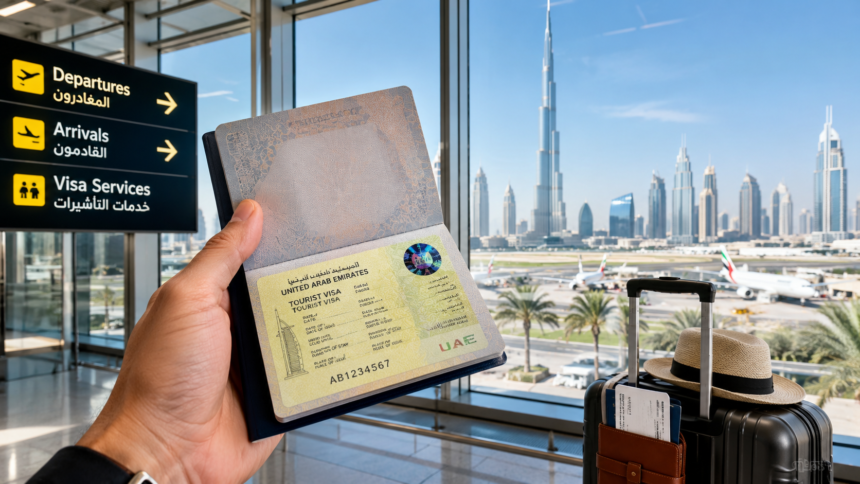
Dubai sells itself, honestly. Tallest building on Earth, a skyline that keeps rewriting its own record, malls the size of small towns. But before any of that, there’s a piece of admin most people would rather skip: sorting out your tourist visa in Dubai. Get it wrong, and you’re not going anywhere near the Burj Khalifa.
- What Is a Tourist Visa in Dubai, and Do You Actually Need One?
- Types of Dubai Tourist Visas You Can Actually Choose in 2026
- Dubai Visit Visa New Rules Today — What’s Actually Changed
- How to Apply for UAE Tourist Visa Online, Step by Step
- Dubai Visit Visa for Pakistani Citizens: What You’ll Need
- Dubai Tourist Visa Fees and Costs in 2026
- Bank Balance and Financial Proof — What’s Really Required
- Extending Your Visa, and What Happens if You Overstay
- Mistakes That Get Applications Rejected or Delayed
- A Few Tips for a Smoother Online Application
- Frequently Asked Questions
- Final Word
Here’s the annoying part about researching this online: half the guides out there are two or three years stale, quoting fees and rules that simply don’t apply anymore. The UAE has overhauled a good chunk of its visa system, and 2026 especially brought some changes that actually matter to your trip. So this guide tries to do one thing well: put the current, accurate picture in one place instead of making you stitch it together from ten browser tabs.
We’ll go through what the visa actually is, the options you have now, what’s changed this year, how the online application works, and — because so many people searching this are from Pakistan — a section built specifically around that. Costs, bank balance questions, extensions, common slip-ups, all of it. Let’s get into it.
What Is a Tourist Visa in Dubai, and Do You Actually Need One?
Put simply, a tourist visa in Dubai is permission from UAE immigration to enter the country for a holiday, family visits, or short-term non-work purposes. It’s not residency. It doesn’t let you take a job. It’s a “come, look around, go home” permit, and that’s it.
Whether you need one at all comes down to your passport. Travellers from the UK, US, most of the EU, Australia, and a handful of other countries either walk in visa-free or get a visa stamped on arrival. Others, including Pakistan, fall firmly in this group — need the paperwork sorted before they even board the flight.
The one bit of good news? The days of queuing at an embassy are largely gone. Most people now handle the whole thing online, through an agency, an airline, or the government portal directly. Upload your documents, pay, wait a few days, and the approval lands in your inbox as a PDF.
Types of Dubai Tourist Visas You Can Actually Choose in 2026
It wasn’t long ago that there was really one option: 30 days, take it or leave it. That’s not the case anymore, and honestly, the flexibility now on offer is one of the more welcome changes.
30-Day Tourist Visa
Still the default for most travellers, and it makes sense — it fits the typical one-to-two-week holiday without you paying for time you won’t use. You can now extend it from inside the country if plans shift, which wasn’t always straightforward before. Expect somewhere around AED 350–550 depending on who you book through.
60-Day Tourist Visa
Good if you’re mixing tourism with a longer family stay, or you just don’t want to be watching the calendar the whole trip. Costs more than the 30-day version, obviously, but you get double the runway, and it’s extendable too.
90-Day Tourist Visa
This one’s newer, and it’s part of why so many people are searching “Dubai visit visa new rules today” this year. A 90-day tourist option genuinely wasn’t a thing a couple of years back. It suits longer family visits or anyone who wants real breathing room without committing to residency.
Five-Year Multiple-Entry Visa
For frequent flyers to the UAE, business travellers, people with family there, repeat holidaymakers. You get five years of coming and going, capped at 90 days per individual visit. Pricier to set up, but if Dubai’s a regular destination for you, it beats reapplying every time.
Visa on Arrival
Available to a growing but still limited list of nationalities. If your passport qualifies, you skip pre-approval entirely and get stamped in at the airport. Pakistani passport holders don’t currently make that list, unfortunately, so pre-arranged approval stays essential.
Dubai Visit Visa New Rules Today — What’s Actually Changed
This is probably the part you clicked through for, and fair enough — getting this wrong can cost you real money or, worse, hold you up at the airport. The 2026 changes are some of the biggest the UAE has made to its visa system in years.
- The overstay grace period is gone. Used to be, you had roughly ten days of buffer after your visa expired before penalties started. Not anymore. Since 11 February 2026, a flat AED 50-per-day fine kicks in from day one, across every emirate and every visa type. No cushion for a missed flight, no exceptions.
- You’ve now got real duration choices. The 90-day option sitting alongside 30 and 60 days means people can actually pick a length that fits their trip instead of defaulting to the shortest one out of habit.
- Extensions don’t require leaving the country. Most 30 and 60-day visas can be extended straight through the ICP portal now, online, no exit-and-re-entry dance required like before.
There’s more beneath those headlines too: tighter document checks during the application itself, mandatory travel insurance tied to certain visa categories, and stricter verification at boarding to make sure what’s on your paperwork matches your actual travel purpose. If the last time you looked into UAE visas was back in 2024, it’s genuinely worth a fresh look before booking anything.
How to Apply for UAE Tourist Visa Online, Step by Step
Applying for a UAE tourist visa online is meant to be simple, and for most people, it genuinely is, assuming your documents are in decent shape.
Start by picking your visa type; the duration you choose shapes both the cost and what documents get asked for. Next, gather your paperwork: passport, a proper photo, and whatever supporting documents apply to your nationality. Then decide how you’re applying: straight through GDRFA’s smart services portal, through an airline like Emirates if you’re booking flights with them anyway, or via a licensed travel agency, which a lot of first-timers prefer just for the hand-holding.
Once it’s submitted and paid for, standard processing usually takes one to five working days, with express options if you’re cutting it close. You’ll get an e-visa back as a PDF, no physical stamp needed beforehand. Immigration handles the actual entry formalities once you land in Dubai.
One thing worth double-checking every single time: the validity dates on your approved visa against your actual travel dates. Small mismatches here cause more airport headaches than almost anything else, and they’re completely avoidable if you just glance at the paperwork properly.
Dubai Visit Visa for Pakistani Citizens: What You’ll Need
Pakistan is consistently one of the top nationalities applying for Dubai visit visas, which makes sense given how much travel happens between the two countries for family, business, and tourism. The process mirrors what we covered above, but there are a few things specific to Pakistani applicants worth flagging.
To answer the obvious question first: yes, the Dubai visa is open for Pakistani citizens heading into 2026, and demand hasn’t dropped off. What Pakistani travellers don’t get, though, is visa on arrival — that’s not currently on the table, so pre-approval before you fly is non-negotiable.
Here’s what you’ll generally need to pull together:
- A valid Pakistani passport with at least six months of validity left from your travel date
- Two recent passport-sized photos on a white background
- A copy of your CNIC — UAE authorities specifically ask Pakistani, Iraqi, Iranian, and Afghan applicants for this
- A recent bank statement showing you can support yourself during the trip
- A confirmed return flight, and often a hotel booking or invitation letter if you’re staying with family
Processing generally runs one to seven working days depending on your provider and whether you go standard or express. Most Pakistani travel agencies and the major airlines offer full application support, which is worth leaning on if this is your first time doing it.
Dubai Tourist Visa Fees and Costs in 2026
Costs shift depending on duration, how fast you need it processed, and whether you go direct through GDRFA or via an agent. The official government fee sits at AED 252 for 30 days and AED 352 for 60 days, both plus 5% VAT. Most travellers, though, apply through an agency or airline, where insurance and service charges get bundled in — pushing the real total closer to AED 350–550 for 30 days and AED 550–900 for 60.
For applicants coming from Pakistan specifically, that roughly translates to PKR 25,000–40,000 for a 30-day visa and PKR 46,000–70,000 for 60 days, though exchange rates move around enough that it’s always worth confirming current pricing before you pay anything. The 90-day and five-year multi-entry options obviously cost more upfront; the five-year visa runs somewhere from PKR 90,000 to 130,000 depending on the agency.
One thing that trips people up: the government fee itself never changes between providers. What varies is the service charge and insurance stacked on top of it, which is exactly why two agencies quoting “the same visa” can hand you two different numbers.
Bank Balance and Financial Proof — What’s Really Required
This is probably the most misunderstood part of the whole process. There’s no officially published minimum bank balance for a standard tourist visa. What immigration and processing agents actually want is proof you can support yourself while you’re there, usually shown through a bank statement covering the last three to six months.
As a rough guide, agencies often suggest showing something in the range of PKR 100,000–150,000 (or your local currency’s equivalent) for a standard 30-day trip — but that’s a practical recommendation, not a legal threshold, and it does vary by provider. If a family member or friend already living in the UAE is sponsoring you, you may not need to show your own statement at all; their financial standing can sometimes cover it instead. Best move either way; just ask your specific agency or airline what they need, since this genuinely isn’t standardised across the board.
Extending Your Visa, and What Happens if You Overstay
Trips change mid-way more often than people plan for. The good news is extending a tourist visa in Dubai got noticeably easier under the 2026 rules. Both 30- and 60-day visas can now be extended online through ICP; no need to physically leave the country first, the way you sometimes had to before.
Where it’s gotten tougher is overstaying. That old grace period? Gone. The second your visa expires, the AED 50-per-day fine starts running automatically — no allowance for a delayed flight or anything else. Go over 30 days, and you’ll also need an exit permit before you’re allowed to leave. Given how strictly this gets enforced now, keeping your expiry date front of mind isn’t optional anymore.
Mistakes That Get Applications Rejected or Delayed
Even with a smoother online system, plenty of applications still stumble, usually over things that are completely avoidable. Blurry photo uploads are more common than you’d expect. So are small mismatches between passport details and what’s typed into the application form. Applying right before your travel date is another one — it leaves zero room if extra documents get requested.
People also tend to underestimate how closely insurance and accommodation proof get checked under the tighter 2026 verification process. And it’s worth saying plainly: stick to recognised agencies, airlines, or the official GDRFA and ICP portals. Unlicensed agents online have become more of a problem as demand for these visas has grown, and it’s not worth the risk to save a small fee.
A Few Tips for a Smoother Online Application
Give yourself two to three weeks before your travel date rather than applying at the last minute — it leaves room for anything unexpected. Keep every document as a high-resolution scan; a pixelated photo is a surprisingly common reason for a bounce-back request.
Check your passport’s got well beyond the minimum six months’ validity, just to be safe. And once your e-visa’s approved, print a couple of copies and save one on your phone too; airlines will often ask to see it before you’re even at the gate.
Frequently Asked Questions
How much is the UAE visa fee?
The government fee itself is AED 252 for 30 days and AED 352 for 60 days, plus 5% VAT. Through an agency or airline, the all-in cost usually lands somewhere between AED 350 and AED 900 depending on duration and how fast you need it.
Is there a 7-day tourist visa for Dubai?
No — there’s no standalone 7-day option. The shortest standard visa is 30 days, though some visa-on-arrival setups for eligible nationalities can grant a shorter stay, closer to 14 days.
Is Dubai visa open for Pakistani 2026?
Yes, it’s open, and demand hasn’t slowed. Pakistani nationals just don’t qualify for visa on arrival, so applying online ahead of travel — through an agency, airline, or GDRFA directly is required.
How long is a UAE visa valid for?
Standard tourist visas run 30, 60, or 90 days from entry. The multiple-entry version extends that to five years overall, with each visit still capped at 90 days.
How much bank balance is required for a Dubai tourist visa?
There’s no fixed legal figure, but agencies commonly recommend showing around PKR 100,000–150,000 in a recent statement to demonstrate you can cover your stay.
How much is a 30-day tourist visa for Dubai?
Typically AED 350–550 through an agency or airline — roughly PKR 25,000–40,000 for applicants from Pakistan, depending on exchange rates and processing speed.
Is there a 90-day tourist visa for Dubai?
Yes — it’s one of the newer options introduced under the 2026 rule changes, sitting alongside the existing 30 and 60-day visas.
Can I get a Dubai visa on arrival?
Depends on your passport. UK, US, most EU, and several other nationalities qualify. Pakistani passport holders currently don’t, so pre-approval before travel stays necessary.
Final Word
The tourist visa in Dubai process has genuinely gotten friendlier over the past year: more duration options, online extensions, a much less painful application flow overall. The flip side is that enforcement’s gotten stricter once you’re actually there, especially around overstaying, so keeping an eye on that expiry date matters more than it used to.
Whether this is your first time applying from Pakistan or you’re weighing up the five-year multi-entry option because you’re back and forth a lot, the basics don’t really change: apply early, keep your documents clean and current, and confirm fees directly with your provider or through GDRFA/ICP before you commit to anything. Do that, and the rest of the trip really is just about the Burj Khalifa.