

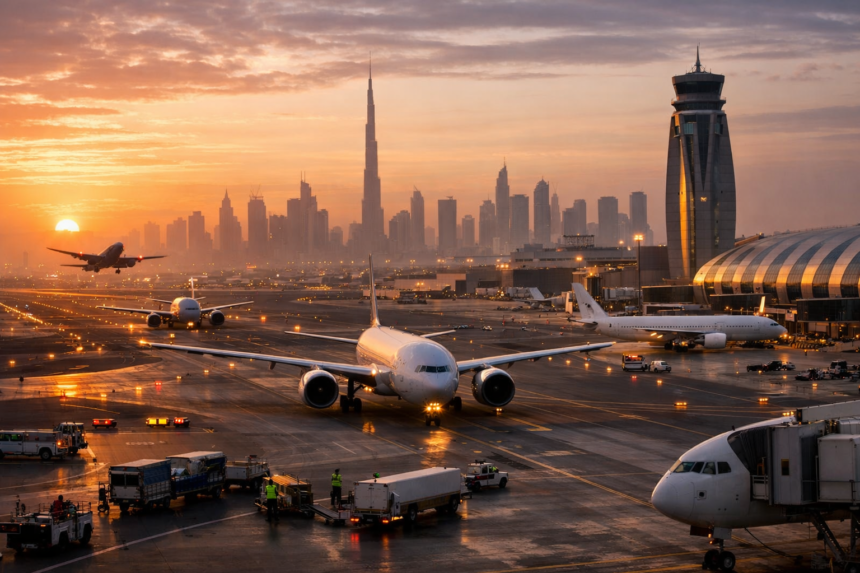
Earlier on March 7, authorities at Dubai International Airport (DXB) announced a temporary stop to all flights.The airport temporarily stopped operations because authorities intercepted an aerial object over the area. Official reports said pieces of the object fell near operational zones, prompting officials to halt arrivals and departures until they could assess the situation.No one suffered serious injuries, but authorities have not yet clarified the exact nature of the object or how they intercepted it.
- What Partial Resumption Means for Travelers
- Why This Matters: Dubai’s Part in Air Travel Around the World
- How Airlines Dealt with the Short-Term Stop
- What Passengers Went Through During the Pause
- Changes in how things work at DXB and DWC airports
- Why the Authorities Took Safety Precautions
- What Passengers Should Expect in the Future
- Why Dubai’s Aviation Hub is Still Strong
- Beyond Dubai’s borders, the world is affected
- Questions that are often asked (FAQs)
- Conclusion
Authorities implemented the break to protect passengers, crew, and ground staff. Despite social media speculation and alarming videos circulating online, officials emphasized that the incident affected only a small area. The Dubai Media Office reaffirmed that the airport followed standard safety protocols, just as it does in normal aviation operations.
Air traffic control required planes in the air to circle for an extended period, while some incoming flights temporarily diverted to nearby airports, including Dubai World Central (DWC), until authorities cleared them to land.
What Partial Resumption Means for Travelers
Later that day, airport officials confirmed that Dubai International Airport was partially open again after a short break.Authorities allowed only a few flights to depart and arrive. Dubai Airports announced on X (formerly Twitter) that the airport had reopened and resumed operations, but airlines scheduled only limited flights while they adjusted to the changing situation.
“Partial resumption” means that some flights are still coming and going from the airport, but not all services are back to normal. Airlines and airport staff are working together to get flights moving again as conditions improve, but schedules can change quickly. Officials strongly advised that passengers not go to the airport without confirmed flight details and that ticket holders should check with their airline before making any plans to go somewhere else.
This partial return to operations was the first step toward restoring full service. It allowed flights to start moving again while keeping safety standards in place. Many airlines, including the main national carrier, changed their flight schedules so that they could start flying again only after getting permission from aviation authorities.
Why This Matters: Dubai’s Part in Air Travel Around the World
Dubai International Airport is more than just a regional airport; it is the world’s busiest airport for international passengers, connecting markets, cultures, and continents. Flights from DXB go to big cities in Europe, Asia, Africa, the Americas, and Oceania. So, any pause in operations, even a short one, has a big effect on travel around the world. Earlier problems that week showed how interconnected the world’s airline networks have become and how quickly news of a halt in the Middle East can affect flights around the world.
Airlines need runways that are easy to get to, airspace that is stable, and passengers that move smoothly.
How Airlines Dealt with the Short-Term Stop
After the temporary suspension, several major carriers had problems with their operations. Emirates, the UAE’s national airline, said that flights were stopped for a short time and then started up again for passengers who had already booked. The airline talked directly to customers and told them to check their flight status online or call support if they needed help.
Emirates’ statement stressed that services were starting up again in a controlled and phased way and that passengers with confirmed bookings for afternoon flights could go to the airport. This advice also applied to people who were connecting through Dubai, as long as their next flights were already booked.
The airline also stressed that safety was still its top priority and that it worked with airport authorities to make changes to the schedule as needed. Because of the incident, Emirates gave affected passengers the option to change their plans without penalty by offering flexible rebooking and refund options.
What Passengers Went Through During the Pause
During the suspension, airport staff asked passengers inside the terminal to remain where they were while teams managed the situation. Staff closed check-in counters, paused boarding procedures, and instructed travelers to stay calm as they implemented safety protocols. According to flight-tracking data, air traffic control required some aircraft to circle in the air until controllers cleared them to land or divert to another airport.
Family and friends of passengers kept up with the latest news on social media and airline channels, but airport officials said that official channels were still the best place to get the most up-to-date information. There were videos and unverified claims online that caused confusion, but official statements tried to calm people down by saying that the situation was under control.
As operations started up again, check-in counters opened up slowly, and boarding started up again for flights that were cleared to leave later in the afternoon. Passengers with confirmed flights went to the airport after their airlines contacted them directly.
Changes in how things work at DXB and DWC airports
Dubai International Airport’s partial reopening was part of a coordinated effort with Dubai World Central – Al Maktoum International Airport (DWC) to keep flights safe during the disruption. The Dubai Airports authority runs both airports together. To cut down on traffic and keep things running as smoothly as possible, flights were spread out between the two airports.
This kind of operational change made it possible for flights to come back in stages, with only certain departure and arrival slots open based on real-time safety checks. The goal was to ease the strain on airport infrastructure while allowing a controlled restart of services for both passengers and cargo operations.
Why the Authorities Took Safety Precautions
It was clear to national and airport officials that the safety of passengers and staff was their top priority. Authorities did not suspend operations because of a confirmed direct attack on the airport. Instead, they intercepted an aerial object near the airport’s airspace. After officials assessed the situation and confirmed that no further risk remained, they restarted airport operations in stages.
Around the world, aviation security rules put risk reduction ahead of keeping operations going. The stop caused problems and delays, but it also showed that authorities could act quickly and decisively to protect people and aircraft equipment. This choice is the result of years of planning for aviation risk management and crisis response.
What Passengers Should Expect in the Future
Dubai International Airport is now partially open again after a short break, and flight schedules are being updated every day. Travelers should know, though, that this situation is still changing. Airlines and airport authorities may keep changing flight times, routes, and connections based on safety checks and airspace permissions.
People who are going to or coming from Dubai should check with their airline often and make sure they have the most up-to-date boarding passes, notifications, and confirmations before they leave for the airport. Travelers should also get to the airport early because security procedures may take longer and terminals are still making changes to how they work.
People who have connecting flights should check their itinerary again, because some connections may still be affected by delays or changes in the schedule as airlines get back to full speed. During this time, patience and flexibility are still very important for people who travel internationally.
Why Dubai’s Aviation Hub is Still Strong
Dubai’s aviation network is still strong and flexible, even though it had to stop for a short time today and has had to deal with irregular operations for the past few days because of tensions in the region. The partial reopening of DXB and coordination with DWC airports show how strong the infrastructure is and how committed the authorities are to safely and efficiently resume services.
Dubai strengthens its reputation as a major global transit hub by restarting flights quickly, adjusting schedules efficiently, and communicating clearly with passengers. Airlines like Emirates and Flydubai, as well as international airlines that send a lot of passengers through Dubai, are working hard to get back on track after problems and win back the trust of travelers from around the world.
Beyond Dubai’s borders, the world is affected
Fortunately, clear communication and a gradual return to normal operations help keep long-term disruptions to a minimum. Airlines will keep working closely with aviation authorities to keep schedules stable and make sure that passengers, cargo, and logistics all keep moving as smoothly as possible.
Questions that are often asked (FAQs)
What made Dubai International Airport stop working?
Authorities temporarily stopped airport operations as a safety measure after intercepting an object flying near the airport’s airspace. Debris fell near active operational areas, so officials halted flights briefly while they implemented safety measures. They confirmed that no one suffered serious injuries and resumed operations once the situation was under control.
Is Dubai International Airport open for business now?
No. Dubai International Airport is starting to operate again after a short break, but it is not yet at full capacity. Only some flights are currently flying, and airlines are still changing their schedules as the situation changes.
Should I go to the airport without getting confirmation?
Authorities strongly advise against going to the airport without confirmed flight details. Passengers should only go to DXB or DWC if their airline has contacted them and they have confirmed their flight times.
What should people do if their flight is canceled?
Many airlines, like Emirates, are letting people who have had their flights canceled rebook or get their money back. For help with your booking, call the customer service number for your airline or go to their official website.
Will things get back to normal soon?
Officials have not announced a timeline for fully restoring normal operations. Airlines and airport officials are checking the situation every day, and as safety and airspace stability improve, more flights should start up again normally.
Conclusion
In conclusion, the fact that Dubai International Airport partially resumes operations after brief pause marks a significant step in restoring global travel confidence. While the temporary suspension caused disruptions for thousands of passengers and airlines, authorities prioritized safety, acted swiftly, and coordinated a phased reopening to minimize impact. The partial resumption allows essential flights to operate, giving travelers flexibility and maintaining Dubai’s critical role as an international aviation hub.
Passengers should regularly check airline communications, confirm their flight details before going to the airport, and plan for any schedule changes.The incident highlights the importance of robust safety protocols in major airports and the ability of aviation authorities to respond effectively in real time. As Dubai International Airport gradually returns to full operations, it reinforces its position as a resilient and well-managed global transit center, capable of handling challenges while ensuring the safety and convenience of all travelers.