
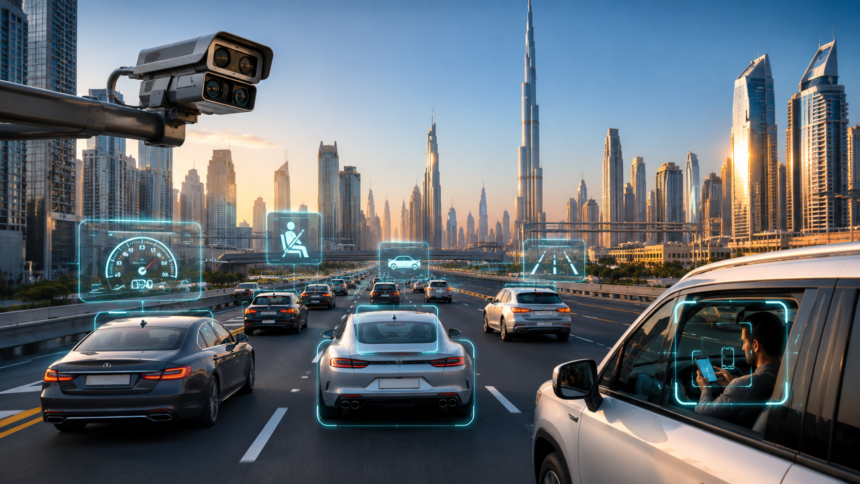
Drive through Dubai these days, and you’ll notice something: the roads are watching back. Smart cameras sit at intersections, along highways, and even in quiet residential streets, running around the clock with artificial intelligence doing most of the detection work that officers used to handle manually. If you get behind the wheel anywhere in the emirate, it pays to know how this system actually works. This guide walks through everything tied to Dubai traffic and radar violations, from the technology itself to the steps you can take to check your record and stay clear of fines.
- What Are Dubai AI Traffic Radars?
- A Brief History of Traffic Enforcement Technology in Dubai
- How Dubai AI Traffic Radars Work
- Types of Dubai AI Traffic Radars
- Common Dubai Traffic AI Radar Violations Drivers Should Know
- Fines and Penalties for Dubai AI Radar Violations
- Understanding the Black Points System and Its Impact on Your License
- How AI Radar Violations Affect Vehicle Insurance and Registration
- Where Dubai Police Place AI Radar Cameras
- AI Radars vs Traditional Speed Cameras: Key Differences
- Role of RTA and Salik Integration with AI Radar Systems
- How to Check Dubai Traffic AI Radar Violations Online
- Tips to Avoid Dubai Traffic AI Radar Violations
- The Future of AI Traffic Enforcement in Dubai
- Why Road Safety Technology Matters for Dubai’s Future
- Frequently Asked Questions
- Conclusion
What Are Dubai AI Traffic Radars?
At their core, Dubai’s AI traffic radars are monitoring units that blend radar hardware, high-resolution cameras, and artificial intelligence software into one package. Older speed cameras only ever cared about one thing: how fast your car moved past a fixed point. These newer systems look at behavior as a whole, and they push that data to Dubai Police servers within seconds of catching something.
Dubai Police rolled these systems out as part of a much bigger smart city push. The AI units now monitor traffic flow live and pick up on violations that older radar simply couldn’t see. It’s a fairly big shift, and it changes how drivers ought to think about the rules of the road.
Here’s the thing worth remembering: one radar unit can now flag several offenses from a single vehicle in one pass. So a quick glance at your phone or forgetting to buckle up isn’t a minor slip anymore it’s a recorded, billable event.
A Brief History of Traffic Enforcement Technology in Dubai
None of this happened overnight. Traffic enforcement in Dubai started decades ago with officer patrols and basic fixed cameras bolted onto poles along the main highways. Those early cameras did one job clock your speed at a single point and that was about it. As the city grew into a global business hub, traffic volume exploded, and single-purpose cameras just couldn’t keep up. Dubai started pouring money into digital infrastructure through the early 2020s, and that groundwork eventually turned into the connected traffic network drivers see today.
By 2025, Dubai Police showed off its Intelligent Traffic System at GITEX Global, and that was a genuine turning point. The platform runs on its own, pulls in live video, and identifies several offenses at once using fast data analysis. From there, the wider AI radar rollout followed pretty quickly across the city. What stands out about this timeline is how gradual it’s been. Dubai didn’t flip a switch overnight — it built one layer on top of another, moving from a basic speed check to a fully connected enforcement network over years, not months.
How Dubai AI Traffic Radars Work
So how does the actual detection happen? A mix of hardware and software work together here. Sensors track speed, lane position, and following distance, while cameras grab clear images even when traffic is heavy or lighting is poor. Machine learning and computer vision do the heavy lifting, scanning footage and flagging offenses without needing an officer physically present.
License plate recognition ties everything together. The moment a plate comes into view, the system reads it instantly and links whatever violation just occurred to the correct vehicle file and owner. Once it catches something, it saves a photo or short clip as proof and sends the file along for processing usually within seconds.
Weather doesn’t really slow these systems down either. A lot of the radar units run infrared and thermal sensors, so they can still read speed and lane position accurately during fog, heavy rain, or in the middle of the night. That’s a big upgrade from the older cameras, which often struggled once visibility dropped.
There’s also a proactive side to all this that people don’t talk about enough. Dubai Police doesn’t just wait for violations to happen; the traffic management system constantly reviews live data on vehicle volume, speed, and movement patterns, then cross-references that against historical records to spot high-risk spots before something goes wrong. Officers can then send patrols or extra radar coverage to those areas ahead of time.
Types of Dubai AI Traffic Radars
Not every camera you pass does the same job. Dubai runs several distinct radar types, each built for a different kind of road environment.
Fixed Point Radars
These are the ones most drivers already know. Fixed point radars sit permanently at set spots along highways and major roads, measuring speed at one exact location. The newer versions now carry AI processing chips, so they catch more than just speed these days.
Mobile Radars
Mobile units move around, sometimes mounted in unmarked vehicles, sometimes set up as portable rigs. Dubai Police uses these to cover stretches of road without permanent camera poles, and honestly, their unpredictable placement is the whole point. Drivers can’t just memorize “safe spots” anymore.
Average Speed Radars
Rather than checking your speed at one point, these radars calculate your average speed across a whole stretch of road. Two linked cameras log when you enter and exit a zone, then the system does the math. This catches the drivers who slow down right at the camera and speed right back up after — a trick that used to work with older systems.
Intersection AI Radars
Intersection radars watch the whole junction, not just a single lane. They pick up red light violations, illegal turns, and unsafe lane changes near the signal. Because they see the full sequence of events at the intersection, they build a much clearer picture of what actually happened than a basic speed camera ever could.
Common Dubai Traffic AI Radar Violations Drivers Should Know
If you want to understand dubai traffic ai radar violations, start with what these cameras are actually looking for. It goes well beyond speed these days, and a lot of drivers get caught off guard by offenses they never expected a camera to notice.
Here’s what these systems currently catch:
- Speeding, across several penalty tiers depending on how far over the limit you’re going
- Red light violations, including entering an intersection after the signal turns red
- Lane breaches, like sudden or unsafe lane changes
- Mobile phone use, spotted through hand movement and screen light detection
- Seatbelt violations, for drivers and passengers alike
- Illegal window tinting, past legal limits
- Excessive vehicle noise, from unauthorized modifications
- Expired registration, flagged automatically once the plate is scanned
Dubai Police’s rollout covers eight distinct offense types across major roads and intersections speeding, red light violations, lane breaches, phone use, seatbelt offenses, illegal tinting, noisy vehicles, and expired registration. That’s why so many drivers end up with more than one fine from a single radar encounter.
Fines and Penalties for Dubai AI Radar Violations
Penalties scale with how serious the offense is, and Dubai Police keeps this structured in fairly clear tiers. Worth knowing these numbers, because the cost adds up fast once you factor in impoundment and black points.
- Extreme speeding more than 80 km/h over the limit can mean a AED 3,000 fine, 60 days of vehicle impoundment, and 23 black points on your license.
- Moderate speeding over 60 km/h above the limit brings a AED 2,000 fine, 20 days of impoundment, and 12 black points.
- Mobile phone use while driving carries roughly AED 800, four black points, and reportedly a 30-day impoundment period.
- Seatbelt violations are smaller but still add up around AED 400 and four black points per offense.
Some violations carry much heavier consequences under UAE law. Decree No. 30 of 2023 covers mandatory administrative impoundment for red light violations, dangerous driving, excessive tinting, and modifications that boost speed or noise. Release payments can reach AED 50,000 for the most serious cases, and around AED 10,000 for tinting or unauthorized modification cases. These numbers make it pretty clear why a “small” habit behind the wheel can turn into a real financial hit.
Understanding the Black Points System and Its Impact on Your License
Fines are only half the story. Every time an AI radar catches you, black points get added to your license, and those carry consequences that go well past whatever you pay upfront.
Hit 24 black points within a year, and Dubai Police suspends your license for a set period. Do it a second time in the same stretch, and you’re looking at a longer suspension plus mandatory traffic awareness courses before you get your license back. This is really the whole point of the system it treats violations as something that adds up over time, not as isolated one-off mistakes.
Black points also stick to your official record, and that can matter for renewals or background checks tied to your driving history. If you manage a company fleet, you probably already keep a close eye on employee black points, since a suspended license means someone can’t do their job.
Getting rid of black points isn’t as simple as paying them off. Dubai’s system reduces points gradually as time passes without new violations, which is a deliberate design choice meant to push long-term behavior change rather than a quick fix.
How AI Radar Violations Affect Vehicle Insurance and Registration
Traffic violations don’t just hit your wallet once. They can shape how insurance companies view you as a driver going forward. UAE insurers increasingly factor violation history into premium calculations, especially if you’ve got multiple offenses in a short window.
A pattern of repeated violations can push renewal premiums higher, or in some cases lead to stricter policy terms altogether. Some insurers ask for a driving history report before finalizing coverage, and a clean record almost always works in your favor. Registration renewal ties in here too Dubai’s RTA generally won’t process your renewal until outstanding fines are cleared.
This connection between radar violations and everyday ownership costs is easy to overlook until it hits you. One overlooked fine can ripple outward into insurance costs, registration headaches, and even resale value down the line if a buyer checks the vehicle’s history before purchase.
Where Dubai Police Place AI Radar Cameras
Gone are the days when radar coverage meant a few fixed poles on the highway. Mobile units and hidden sensors now show up in places drivers wouldn’t expect, and that unpredictability is by design it pushes everyone toward consistent driving instead of just slowing down near familiar camera spots.
Coverage now spans major highways, busy intersections, school zones, and residential streets. Cameras aren’t confined to traditional poles anymore; mobile and silent units operate in spots drivers don’t typically anticipate. And Dubai Police keeps expanding this network as part of its longer-term smart city plan.
Intersection radars work a bit differently from highway units. Instead of tracking one number like speed, they watch the entire sequence of events at a junction — red light violations, unsafe lane use near the signal, illegal turns, all captured in one frame. That gives officers a far more complete picture of what happened at high-risk points in the road.
AI Radars vs Traditional Speed Cameras: Key Differences
A lot of drivers still picture traffic cameras as basic speed traps, but AI radars operate on a completely different level. Old-school speed cameras measured velocity at one fixed point and flagged you if you crossed the limit that’s it. They couldn’t see anything else happening in or around the vehicle.
AI radars process several data streams at once. Speed detection, lane tracking, gesture recognition, light-pattern analysis all running together to catch things like phone use or a missing seatbelt. One camera now effectively does the job that used to require several separate systems working independently.
Older cameras also relied on manual review, with officers checking footage before any fine went out. AI radars cut most of that delay out entirely — the system processes footage instantly and sends violations straight to Dubai Police’s backend for fine creation. That’s exactly why drivers often get notified so quickly after something happens. Going from traditional cameras to AI-powered enforcement isn’t just a hardware swap. It’s a real leap in how Dubai approaches road safety strategy overall.
Role of RTA and Salik Integration with AI Radar Systems
Dubai’s radar network doesn’t run in isolation; it connects into the broader transportation system managed by the Roads and Transport Authority, creating one unified way to track vehicle movement across the emirate.
It also links up with the Salik toll network, which already tracks vehicles passing through toll gates citywide. Combine radar data with toll data, and authorities get a much fuller view of traffic flow, vehicle history, and driving patterns. This integration is really what makes the broader enforcement system in Dubai work as smoothly as it does. For drivers, this connected setup is actually a bit of a convenience. Instead of checking five different platforms, most fines, toll charges, and registration status can be reviewed through one RTA or Dubai Police portal.
How to Check Dubai Traffic AI Radar Violations Online
Good news here: you don’t need to visit a police station to check your record anymore. Dubai Police built fast digital channels specifically so drivers can check from home, or honestly, from anywhere with an internet connection.
Here’s how to check your status:
- Visit the official Dubai Police website or open the Dubai Police smart app
- Log in with your Emirates ID or registered account
- Head to the traffic fines or violations section
- Enter your vehicle plate number to pull up your record
- Review any listed violations, fine amounts, and black points
- Pay outstanding fines directly through the same portal if needed
The whole process takes a few seconds, and there’s zero need to stand in line anywhere. That kind of convenience makes it a lot easier to stay on top of your record instead of getting blindsided by a fine you didn’t know about.
Tips to Avoid Dubai Traffic AI Radar Violations
A few small habit changes go a long way here. Since these radars track so much at once, staying alert really does matter more than it used to.
Keep your phone out of reach while driving even a quick glance can trigger a flag. Buckle up before you pull out, and make sure your passengers do too. Stick to posted speed limits instead of relying on memory of where cameras used to be, since coverage now stretches far beyond the usual spots people remember.
Signal early and shift lanes gradually rather than cutting across traffic at the last second. Keep a safe following distance too, especially on fast highways where tailgating detection has gotten a lot more common lately. And don’t let your registration lapse expired documents get flagged automatically the moment a camera reads your plate.
The Future of AI Traffic Enforcement in Dubai
This network isn’t done growing. Dubai officials have hinted at deeper predictive capabilities coming down the line, aiming to flag risky driving patterns before violations even happen rather than just recording them after the fact.
Future upgrades could bring tighter integration with autonomous vehicle systems, smarter traffic light coordination, and wider coverage across residential neighborhoods that currently sit outside the main network. Officials have also talked about cutting accident rates by encouraging safer habits alongside continued enforcement upgrades. As the AI tools behind all this keep improving, the gap between a violation happening and a driver getting notified will likely shrink even further. It’s a pretty clear signal that Dubai sees this as a long-term investment, not a temporary experiment.
Why Road Safety Technology Matters for Dubai’s Future
At the end of the day, Dubai’s investment in AI traffic monitoring is about more than collecting fines. Officials have said pretty directly that the goal is safer habits across the entire driver population, not just punishing people after mistakes happen.
As the network keeps expanding, drivers who actually understand how it works will adapt faster and avoid fines they didn’t see coming. Staying informed about dubai traffic ai radar violations isn’t just about protecting your wallet, either. It’s part of a shared responsibility to keep Dubai’s roads safe for everyone using them, residents, commuters, and visitors alike.
Frequently Asked Questions
1. What exactly are Dubai AI traffic radars?
They’re smart camera and sensor systems that use artificial intelligence to catch multiple traffic violations automatically, without needing an officer physically present.
2. How many violations can one Dubai AI radar detect?
Many units can catch up to eight different offenses in a single pass things like speeding, phone use, seatbelt violations, and red light infractions.
3. Can AI radars catch mobile phone use while driving?
Yes. The system picks up on hand movement patterns and detects the light coming off a phone screen inside the car.
4. What’s the fine for extreme speeding in Dubai?
Going more than 80 km/h over the limit can bring a AED 3,000 fine, a 60-day vehicle impoundment, and 23 black points.
5. How do I check if I have any Dubai traffic AI radar violations?
Log into the Dubai Police website or app, enter your plate number, and your violation history comes up right away.
6. Do AI radars work at night or in bad weather?
Yes — a lot of units run infrared and thermal sensors, so they stay accurate even in fog, rain, or low light.
7. Are AI radar cameras only placed on highways?
No. Coverage now includes intersections, school zones, residential streets, and mobile or hidden units in spots you might not expect.
8. What happens when I reach 24 black points?
Dubai Police suspends your license for a set period, and hitting that mark twice in the same year can mean a longer suspension plus mandatory traffic courses.
9. Do traffic violations affect my car insurance in Dubai?
Yes. Insurers often factor violation history into renewal premiums, and repeated offenses can push your rates up or tighten your policy terms.
10. Why did Dubai upgrade to AI radar systems?
It’s part of the city’s smart city vision of reducing accidents, tightening enforcement consistency, and analyzing traffic patterns before problems happen instead of just after.
Conclusion
Dubai’s AI traffic radars have changed the game for drivers across the emirate. These systems don’t just clock your speed anymore — they watch for phone use, seatbelts, lane changes, and a handful of other habits all at once, and they do it fast. Staying clear of Dubai traffic ai radar violations really comes down to a few basics: buckle up, keep your phone down, stick to the speed limit, and check your record online every so often so nothing sneaks up on you. Get those habits right, and you’ll spend a lot less time worrying about fines and a lot more time just getting where you’re going.