
Planning a trip through the UAE often starts with one simple question: how many terminals are there in Dubai Airport, and which one do I need? The answer matters more than most travellers expect. Dubai’s main airport is large, its terminals are not all in the same place, and heading to the wrong one can cost you valuable time.
- The Short Answer: How Many Terminals Does Dubai Airport Have?
- Dubai Airport Terminals at a Glance
- Understanding Each Dubai Airport Terminal
- How the Concourses Fit In
- Key Features of Dubai International Airport
- Features That Travellers Notice First
- Why These Features Matter
- How the Dubai Airport Terminals Work Together
- Moving Between Terminals
- Check-In, Security and Boarding
- Practical Applications: Real-Life Examples
- Tips for Using Dubai Airport Terminals Smoothly
- Dubai’s Second Airport: Al Maktoum International (DWC)
- Why Knowing the Terminal Layout Matters for UAE Residents and Businesses
- Common Mistakes Travellers Make
- How to Get To and From Each Dubai Airport Terminal
- The Best Way to Time Your Arrival at a Dubai Airport Terminal
- Tips for Airport Pickups and Drop-Offs
- Frequently Asked Questions
This guide gives you the direct answer first, then walks through every terminal, the airlines that use them, how to move between them, and what the future holds as Dubai builds a second mega-hub. Whether you are a resident, a visitor, a business traveller, or a travel content creator, you will find practical, verified information below.
The Short Answer: How Many Terminals Does Dubai Airport Have?
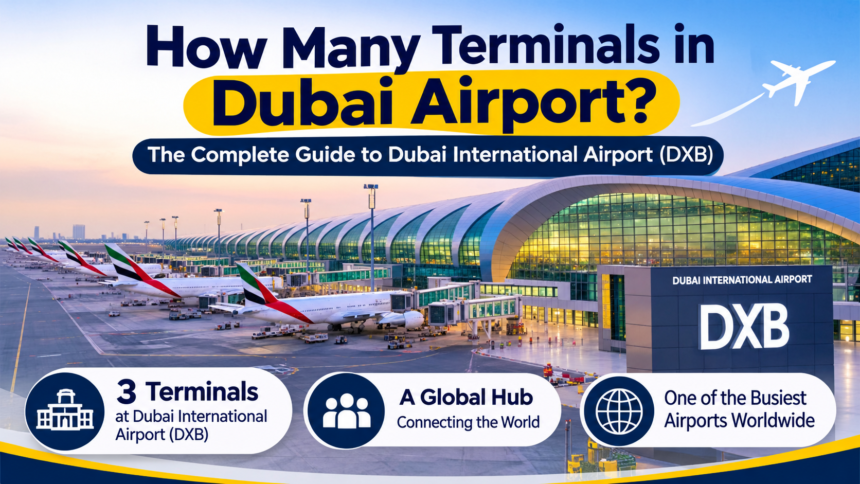
Dubai International Airport (DXB) has three passenger terminals: Terminal 1, Terminal 2 and Terminal 3.
That is the number most people are looking for, because DXB is the airport almost everyone means when they say “Dubai airport.” Gates at DXB are grouped into lettered concourses: Concourse D belongs to Terminal 1, while Concourses A, B and C belong to Terminal 3.
There is one more detail worth knowing. Dubai has a second airport, Al Maktoum International Airport (DWC), located in Jebel Ali. It currently operates a single passenger terminal, which opened in 2013, and it is the site of one of the largest aviation construction projects in the world. We cover it in a dedicated section below.
So the full picture looks like this:
- DXB: three passenger terminals (T1, T2, T3)
- DWC: one operating passenger terminal today, with a very large new terminal under construction
Dubai Airport Terminals at a Glance
Before going deeper, here is a quick overview of the Dubai airport terminal layout at DXB.
| Terminal | Typical Use | Concourses | Metro Access |
| Terminal 1 | Many international airlines | Concourse D | Red Line station |
| Terminal 2 | Regional and low-cost carriers | Single building | Shuttle link to the nearby GGICO station |
| Terminal 3 | Emirates | Concourses A, B, C | Red Line station |
Airline allocations can change, so always check the terminal printed on your e-ticket or shown in your airline’s app before leaving for the airport. This is the single most useful habit for any traveller using DXB.
Understanding Each Dubai Airport Terminal
Terminal 1 (T1)
Terminal 1 serves a wide range of international airlines and houses the D-gates used for international flights. If you are flying with a foreign carrier that is not based in Dubai, there is a good chance you will depart from here.
Terminal 1 is connected to the Dubai Metro Red Line, which makes it one of the easiest terminals to reach from Deira, Bur Dubai and Downtown without a taxi. It has also been in the middle of a refurbishment programme, with new flooring and additional security lanes being installed, according to Dubai Airports’ chief executive.
Passengers in Terminal 1 can expect the usual range of airport services: Dubai Duty Free outlets, restaurants and cafés, prayer rooms, free Wi-Fi and paid sleeping pods in the Sleep ‘n Fly lounges.
Terminal 2 (T2)
Terminal 2 is the smaller of the three and sits physically apart from Terminals 1 and 3. It is generally associated with regional and low-cost airlines, including flydubai.
Because Terminal 2 is separate, it is also the terminal where passengers most often lose time. Connecting between T2 and the other terminals relies on a shuttle rather than the airport’s automated train, so extra time is essential. Terminal 2 links to the Dubai Metro via a shuttle connection to the nearby GGICO station.
If your journey starts or ends in Terminal 2, build in a comfortable buffer, especially if you are being picked up by a friend, family member or driver who needs to know exactly where to meet you.
Terminal 3 (T3)
Terminal 3 is the largest and most recognisable of the Dubai airport terminals. It is the home of Emirates and is made up of three concourses: A, B and C. An automated people mover helps passengers move between concourses, and the Dubai Metro Red Line also serves this terminal.
Terminal 3 is where most long-haul connections happen. Its facilities include the airside Dubai International Hotel, which sells rooms in hourly blocks so transit passengers can rest and shower without going through immigration, along with Sleep ‘n Fly pods, lounges, a large Dubai Duty Free presence, and a wide range of dining options.
A note on flydubai: some sources describe flydubai as operating from Terminal 2, while others mention partner operations in Terminal 3. This is a good example of why checking your own booking beats relying on general rules.
How the Concourses Fit In
Many travellers confuse concourses with terminals, which is one reason the question “how many terminals in Dubai airport” gets different answers online.
A terminal is the main building where you check in and clear security. A concourse is an airside area, reached after security, where the boarding gates are located. At DXB:
- Concourse D is attached to Terminal 1
- Concourses A, B and C are attached to Terminal 3
This is why some websites say “three terminals and four concourses” while others quote a different concourse count. The three-terminal figure is the stable one. Concourse numbers depend on how a source counts remote or satellite gate areas, so treat any single concourse figure with caution unless it comes from the airport operator.
Key Features of Dubai International Airport
DXB is consistently described as the busiest airport in the Middle East, and one of the busiest in the world for international travellers. In 2024, it welcomed more than 90 million passengers across its terminals. Several features explain why it is so widely used.
Features That Travellers Notice First
- Free Wi-Fi: unlimited and available throughout the airport
- Dubai Duty Free: multiple outlets across all three terminals, with the largest presence in Terminal 3
- Lounges and sleep pods: a wide mix of airline lounges, pay-in lounges and Sleep ‘n Fly pods
- Airside hotel: the Dubai International Hotel in Terminal 3, designed for transit stays
- Prayer rooms: available across the airport
- Metro connections: direct Red Line access at Terminals 1 and 3
- Car rental desks: available in all three terminals
Why These Features Matter
For a UAE audience, these details are not just trivia. Residents use DXB for family travel, business trips, and holidays, while visitors often have only a few hours between flights. Knowing that a transit hotel exists, or that Wi-Fi is free, can turn a stressful layover into a manageable one.
How the Dubai Airport Terminals Work Together
Understanding the functionality of the airport helps you plan smarter journeys. DXB runs as a single airport with several connected parts, but the terminals do not all operate in the same way.
Moving Between Terminals
The way you move between terminals depends on which two you are connecting:
- Terminal 1 and Terminal 3: these are the best connected. The Metro Red Line serves both, and the airport’s automated train moves passengers between parts of Terminal 3.
- Terminal 2 and the rest of DXB: this is where a shuttle is needed. Plan extra time, because Terminal 2 is physically separate.
- Within Terminal 3: an automated people mover links Concourse A with the main building, and walkways connect the other concourses.
Whenever you switch terminals, allow extra time for re-screening and check-in procedures. As a rule of thumb, inter-terminal transfers can easily take 20 to 30 minutes by shuttle, and that is before security queues.
Check-In, Security and Boarding
Each terminal has its own check-in halls, security checkpoints, and gates. Passengers connecting between flights on the same itinerary are usually guided through transfer security rather than the main departure security, but the exact process depends on the airline and ticket type. If you are unsure, ask your airline or look for transfer signage on arrival.
Practical Applications: Real-Life Examples
Knowing the terminal layout is useful in everyday situations. Here are a few realistic examples of how this information is applied.
Example 1: The Family Airport Pickup
A resident in Al Qusais is collecting relatives arriving on a low-cost carrier. The assumption that “all flights land at the big terminal” would send the driver to the wrong place. By checking the arrival terminal on the airline app, the driver goes straight to the right entrance and avoids waiting at the wrong curb.
Example 2: The Tight Connection
A traveller connecting from an international carrier in Terminal 1 to an Emirates flight in Terminal 3 will need to account for the transfer between the two terminals. Knowing that both are on the Metro Red Line, and that Terminal 3 has multiple concourses, helps the traveller plan realistic timing rather than relying on the connection time printed on the booking alone.
Example 3: The Long Layover
Someone with a layover of several hours can use the airside Dubai International Hotel in Terminal 3 for a short rest, or a Sleep ‘n Fly pod in Terminal 1 or Terminal 3. These facilities exist precisely for passengers who do not want to leave the airport or clear immigration.
Example 4: The Business Traveller
A professional landing at DXB for back-to-back meetings can use the Metro from Terminal 1 or Terminal 3 to reach Downtown, avoiding road traffic during rush hour. Terminal 2 passengers need to factor in the shuttle to the nearest Metro station.
Example 5: The Travel Content Creator
A travel blogger or brand writing about Dubai needs facts to be correct. Saying “Dubai airport has three terminals” is accurate for DXB, but adding that DWC also operates as a separate airport makes the content more complete and more trustworthy for readers and search engines alike.
Tips for Using Dubai Airport Terminals Smoothly
These practical steps apply whether you are travelling for work, leisure, or family reasons.
- Check your terminal early. Confirm it on your e-ticket or airline app, ideally the day before travel.
- Allow extra time for Terminal 2. Because it is separate, drop-offs, pickups, and transfers take longer.
- Use the Metro where possible. Terminals 1 and 3 have direct Red Line stations, which is often faster than a taxi at peak times.
- Plan terminal changes carefully. Allow at least 20 to 30 minutes for shuttle transfers, plus time for security.
- Know where your concourse is. In Terminal 3, Concourses A, B, and C are different areas, and walking times can be significant.
- Keep a charged phone. Gate changes and terminal updates are communicated through airline apps and airport screens.
Dubai’s Second Airport: Al Maktoum International (DWC)
Any complete answer to “how many terminals in Dubai airport” should mention Al Maktoum International Airport, also known as Dubai World Central or DWC. It is located in Jebel Ali and is Dubai’s second airport.
The Current Situation
DWC currently operates a single passenger terminal, which opened in October 2013. It is much quieter than DXB, but it has an important future.
The Future Terminal
In April 2024, the Ruler of Dubai approved designs for a new passenger terminal at DWC with a budget of AED 128 billion (about USD 35 billion). Once fully built, the airport is planned to handle more than 260 million passengers a year, with around 400 gates and five parallel runways.
Dubai Airports has stated that the first phase is scheduled for completion in 2032, with an initial capacity of 150 million passengers a year. Contracts worth AED 13 billion have already been awarded this year, and a further AED 55 billion in contracts is expected to be awarded before the end of 2026. Upcoming works include the Western Passenger Terminal, a baggage handling system, an automated people mover and a fourth concourse.
Some earlier reports described the future airport as having four terminals, but the official project descriptions focus on concourses, a western passenger terminal and phased delivery, so it is safer not to quote a final terminal count for DWC until the operator confirms one.
What This Means for DXB
DXB is not closing today. Dubai’s leadership has said DXB will continue to serve as the primary hub in the coming years while the new airport takes shape. The longer-term plan is for operations to move gradually from DXB to DWC, with the first phase expected to open in 2032.
In the meantime, DXB is still investing. Dubai Airports has referred to a refurbished “hammerhead” remote terminal off Concourse B and a new retail area, alongside the Terminal 1 refurbishment mentioned earlier.
Why Knowing the Terminal Layout Matters for UAE Residents and Businesses
The terminal question is more than a travel detail. For UAE-based audiences, it connects to real decisions.
For Residents
Families planning airport runs, school holiday trips, or visits from relatives benefit from clear terminal information. It reduces stress, avoids missed flights, and helps with arranging drivers and pickups.
For Tourists and Visitors
First-time visitors often arrive without local knowledge. Clear information on which terminal an airline uses and how to reach the city helps them start their trip on the right foot.
For Businesses and Content Publishers
Hotels, tour operators, car rental companies, relocation services and travel brands all benefit from accurate airport information on their websites. Content that answers specific questions, such as how many terminals Dubai Airport has, can attract high-intent readers who are already planning a trip.
Common Mistakes Travellers Make
A few errors appear again and again. Avoiding them can save time and money.
- Assuming one terminal serves all airlines. DXB has three, and they are not interchangeable.
- Confusing DXB with DWC. They are two different airports in different parts of Dubai.
- Underestimating Terminal 2 distances. It is separate from Terminals 1 and 3, so allow extra time.
- Relying on old information. Airline terminal allocations and airport facilities can change, so always check current details.
- Forgetting about re-screening. Changing terminals usually means going through security again.
How to Get To and From Each Dubai Airport Terminal
Choosing the right transport option depends on your terminal, your luggage and the time of day. Each option below suits a different type of traveller.
Dubai Metro
The Red Line stops at Terminal 1 and Terminal 3, which makes it a practical choice for solo travellers, commuters and anyone heading to Downtown, Deira or Bur Dubai. It avoids road traffic, which is useful during busy hours. Terminal 2 does not have its own station, so passengers use a shuttle link to the nearby GGICO station.
Taxis and Ride-Hailing
Taxis and ride-hailing services serve all three terminals and are often the simplest option for families or travellers with heavy luggage. Always tell the driver your exact terminal, not just “Dubai airport”, because the terminals are not side by side.
Car Rental and Private Drivers
Car rental desks are available in all three terminals, which suits visitors planning to explore the UAE by road. If you are booking a private driver, share your terminal and flight number in advance so the pickup point is clear.
The Best Way to Time Your Arrival at a Dubai Airport Terminal
Arriving at the right time matters as much as arriving at the right terminal. International departures from busy terminals need extra time for check-in, security, and passport control, so follow the check-in window recommended by your airline and add a safety margin during peak travel periods. If you are departing from Terminal 2, or transferring between terminals, leave even more time because of the shuttle journey. At dubaiprsubmission.com, we encourage readers to treat airline guidance as the minimum rather than the target, especially for first-time visitors and families travelling with children.
Tips for Airport Pickups and Drop-Offs
Pickups cause more confusion than almost any other airport task. Confirm the arrival terminal on the airline’s website or app, and share it with whoever is collecting you. Arrivals can take time to clear immigration and collect baggage, so a short delay is normal. For drop-offs, check the departure terminal and give the driver a clear drop-off point. Travel and hospitality brands that publish helpful guides like this one on dubaiprsubmission.com can make this experience easier for readers by keeping their terminal information accurate and up to date.
Frequently Asked Questions
How many terminals are there in Dubai airport?
Dubai International Airport (DXB) has three passenger terminals: Terminal 1, Terminal 2 and Terminal 3. Dubai’s second airport, Al Maktoum International (DWC), currently has one operating passenger terminal.
Which terminal does Emirates use at DXB?
Emirates operates from Terminal 3, which includes Concourse A, B, and C.
Which terminal is used by flydubai?
Flydubai is generally associated with Terminal 2, though some sources mention operations in Terminal 3 as well. Always check the terminal printed on your ticket.
How many concourses does Dubai airport have?
Terminal 1 includes Concourse D, and Terminal 3 includes Concourse A, B, and C. Counts vary between sources, so rely on the airport operator for the most current figure.
Can I walk between Dubai airport terminals?
Terminals 1 and 3 are served by the Dubai Metro, and terminal transfers generally rely on trains or shuttles rather than walking. Terminal 2 is separate and uses a shuttle connection.
Is there a hotel inside Dubai airport?
Yes. The Dubai International Hotel is located airside inside Terminal 3 and sells rooms in hourly blocks, so transit passengers can rest without clearing immigration.
Does Dubai airport have free Wi-Fi?
Yes. Free, unlimited Wi-Fi is available throughout DXB.
Is Dubai airport moving to Al Maktoum International Airport?
Dubai has announced plans to gradually shift operations from DXB to DWC, with the first phase of the new terminal scheduled for 2032. DXB continues as the primary hub in the meantime.
How long does it take to transfer between terminals?
Shuttle transfers can take around 20 to 30 minutes, and that does not include re-screening. Allow generous extra time for tight connections.
How do I find my terminal before I travel?
Check your e-ticket, your airline’s app, or the official Dubai Airports flight information pages. Do this the day before travel and again on the day.
Conclusion
So, how many terminals are there in Dubai Airport? The answer is three at Dubai International Airport (DXB): Terminal 1, Terminal 2 and Terminal 3, supported by concourses A, B, C and D. Dubai’s second airport, Al Maktoum International (DWC), currently has a single passenger terminal, and it is the focus of a very large expansion programme with a first phase planned for 2032.
For travellers, the practical lesson is simple: confirm your terminal, allow extra time when changing between terminals, and use the Metro where it makes sense. For UAE-based businesses and content creators, accurate airport information builds trust with readers and helps your content stand out in search results.
If you publish travel, hospitality, or aviation content in the UAE and want your brand story to reach a wider audience, contact us and our team will help you reach readers who are already searching for answers like this one.