

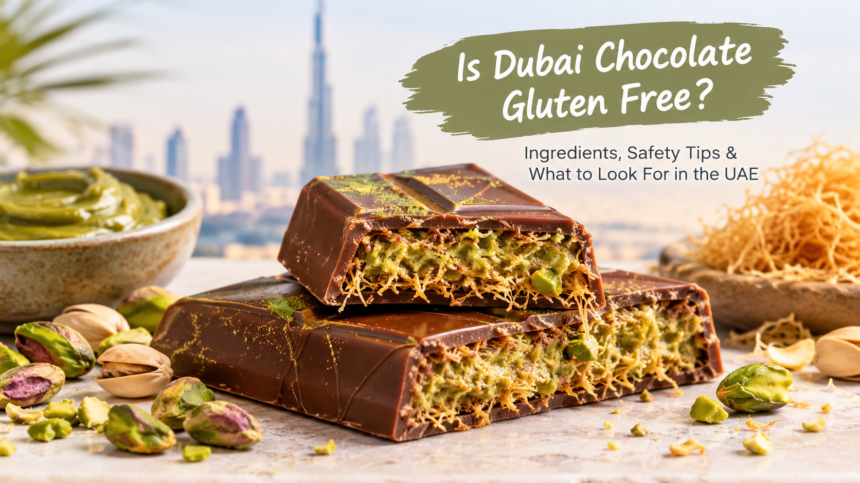
Dubai chocolate has become a popular treat for chocolate lovers who enjoy the combination of creamy pistachio filling, rich chocolate, and a crispy pastry centre. Its distinctive texture and attractive appearance have made it a favourite for gifting, desserts and social media food trends across the UAE and beyond.
- What Is Dubai Chocolate?
- Is Dubai Chocolate Gluten Free?
- Why Does Traditional Dubai Chocolate Contain Gluten?
- Which Dubai Chocolate Ingredients Contain Gluten?
- Can You Buy Gluten-Free Dubai Chocolate in the UAE?
- Look for a Clear Gluten-Free Statement
- Read the Ingredient List
- Check the Allergen Declaration
- Contact the Seller When Necessary
- Is Dubai Chocolate Safe for People With Celiac Disease?
- Is Gluten-Free Dubai Chocolate Suitable for Gluten Sensitivity?
- How to Make Gluten-Free Dubai Chocolate at Home
- Common Mistakes to Avoid When Buying Dubai Chocolate
- Frequently Asked Questions
- Conclusion: Should You Choose Gluten-Free Dubai Chocolate?
However, if you follow a gluten-free diet, you may be wondering: is Dubai chocolate gluten-free?
The short answer is that traditional Dubai-style chocolate is generally not gluten-free because its signature crunchy filling usually contains kataifi pastry made from wheat flour. Nevertheless, some manufacturers and home cooks offer alternative versions that replace conventional pastry with gluten-free ingredients.
Whether you are shopping in Dubai, ordering chocolate online in the UAE, or preparing a dessert at home, understanding the ingredients is essential. In this guide, we explain which ingredients may contain gluten, how to read product labels, what people with celiac disease should consider, and how to find a suitable alternative.
What Is Dubai Chocolate?
Dubai chocolate is a style of filled chocolate bar commonly associated with a combination of chocolate, pistachio cream, and crispy kataifi pastry. Some recipes also include tahini, butter, sugar, or additional flavourings.
The chocolate shell provides a smooth outer layer, while the pistachio filling adds a creamy, nutty flavour. Inside, thin strands of toasted pastry create the crunch that distinguishes this dessert from many ordinary filled chocolate bars.
Although recipes vary between manufacturers, the traditional combination of pistachio cream and crispy pastry is an important feature of the popular Dubai-style chocolate.
Today, you can find variations made with milk chocolate, dark chocolate, white chocolate, and different fillings. Some products also use alternative crunchy ingredients, making it important to check each product individually rather than relying on its name alone.
Is Dubai Chocolate Gluten Free?
Traditional Dubai chocolate is generally not gluten-free because the kataifi pastry used in its filling is commonly made from wheat flour. Wheat contains gluten, a group of proteins found in wheat and certain other grains. When a chocolate bar contains conventional wheat-based kataifi, the finished product contains gluten.
For example, some commercially sold Dubai-style chocolate products explicitly list wheat flour in their kataifi ingredients and declare gluten as an allergen. This confirms why checking the actual product label matters. See the ingredient information published for Barlo Dubai Chocolate with Pistachio. However, not every product marketed as Dubai chocolate uses the same recipe. A manufacturer may replace wheat-based pastry with a gluten-free alternative, such as a suitable rice-based or corn-based crispy ingredient.
That means the answer depends on the specific product.
Before purchasing a bar, check the complete ingredient list, allergen declaration, and any gluten-free statement supplied by the manufacturer. If the information is unclear, contact the seller or manufacturer before eating it.
Why Does Traditional Dubai Chocolate Contain Gluten?
The main concern is usually the crunchy pastry inside the pistachio filling, rather than the chocolate itself.
1. Kataifi Pastry
Kataifi, also spelled kadayif, is a finely shredded pastry used in several Middle Eastern and Mediterranean desserts. It is closely associated with the crispy filling found in traditional Dubai-style chocolate.
Conventional kataifi is commonly prepared using wheat flour, water, and other ingredients. Because wheat flour contains gluten, this pastry is not suitable for a gluten-free diet.
Even if the pastry makes up only a small percentage of a chocolate bar, it can still introduce gluten into the finished product.
2. Pistachio Cream
Pistachios are naturally gluten-free. A simple pistachio paste made from pistachios alone does not contain gluten by nature.
However, commercial pistachio creams may include additional ingredients such as sugar, milk powder, vegetable oils, flavourings, biscuits or other components. Formulations differ between brands.
The pistachio filling may therefore require its own ingredient check. Do not assume that a green-coloured pistachio cream is gluten-free simply because it contains nuts.
3. Chocolate Shell
Plain chocolate made from cocoa ingredients, sugar and other gluten-free components can be suitable for a gluten-free diet.
Nevertheless, flavoured chocolate and filled chocolate products may contain ingredients such as biscuit pieces, wafers, malt-based ingredients, or other additions that introduce gluten.
Manufacturing and handling practices can also affect whether a product is appropriate for someone who needs to avoid gluten strictly.
4. Other Filling Ingredients
Some Dubai chocolate recipes use tahini, butter, milk powder, sugar, or vegetable oil.
These ingredients do not automatically make a recipe unsuitable for a gluten-free diet. Their suitability depends on the specific product and any additional ingredients or cross-contact risks.
The key point is to evaluate the complete recipe instead of judging the chocolate by just one ingredient.
Which Dubai Chocolate Ingredients Contain Gluten?
The following table provides a practical guide to common ingredients. It describes their usual gluten status, not a guarantee about any particular packaged product.
| Ingredient | Usual gluten status | What to check |
| Wheat-based kataifi | Contains gluten | Look for wheat flour in the ingredients |
| Plain pistachios | Naturally gluten-free | Check for added ingredients and cross-contact |
| Plain cocoa and chocolate ingredients | Often gluten-free | Check flavourings, inclusions and allergen warnings |
| Tahini made from sesame seeds | Naturally gluten free | Check the product label and handling |
| Plain sugar | Gluten free | Check the complete recipe for other ingredients |
| Milk powder | Naturally gluten-free | Check for additional ingredients |
| Biscuit or wafer pieces | Often contain gluten | Look for wheat, barley or other gluten-containing grains |
| Rice-based crispy ingredients | May be gluten-free | Verify ingredients and manufacturing controls |
| Corn-based pastry alternatives | May be gluten free | Check the full formulation and cross-contact information |
Gluten can occur in processed foods through ingredients derived from wheat, barley, and rye. The US National Institute of Diabetes and Digestive and Kidney Diseases explains the importance of reading labels and checking for cross-contact when following a gluten-free diet. Its guidance is available at Eating, Diet, & Nutrition for Celiac Disease.
Can You Buy Gluten-Free Dubai Chocolate in the UAE?
Yes, gluten-free versions are possible, but you should verify individual products before buying them.
In the UAE, shoppers may encounter Dubai-style chocolate in supermarkets, speciality chocolate shops, bakeries, gift stores and online shops. Product recipes, packaging and allergen information can vary considerably.
Instead of assuming that a particular shop or brand offers a safe option, use the following approach.
Look for a Clear Gluten-Free Statement
Choose a product with a clear gluten-free claim or credible certification where available. Then check that the claim applies to the exact product you are purchasing.
A gluten-free statement is more useful than a general description such as premium, natural, artisanal, or pistachio chocolate.
Read the Ingredient List
Check for wheat flour, wheat starch that is not specifically suitable for a gluten-free diet, conventional kataifi, biscuits, wafers, and other ingredients that may contain gluten.
Also look for barley, rye, and malt-derived ingredients where relevant.
If the packaging is unclear or the ingredients are unavailable, ask the manufacturer for confirmation.
Check the Allergen Declaration
A statement such as “contains wheat” or “contains gluten” indicates that the product is not suitable for a gluten-free diet.
A warning such as “may contain wheat” requires particular attention if you have celiac disease. It can indicate a possible cross-contact risk, and you should not assume the product is safe.
The absence of a warning is not, by itself, proof that a product is gluten-free.
Contact the Seller When Necessary
If you are ordering from a UAE online shop, ask the seller for the current ingredient list and manufacturer allergen information.
For people with celiac disease, it is also important to understand whether the product is made using suitable manufacturing and handling controls.
A seller’s verbal assurance may not be enough if the manufacturer cannot verify the product’s ingredients and cross-contact controls.
Is Dubai Chocolate Safe for People With Celiac Disease?
People with celiac disease must avoid gluten because eating it can trigger an immune response that damages the small intestine.
For this reason, conventional Dubai chocolate containing wheat-based kataifi is not suitable for people with celiac disease.
Even when a product uses a gluten-free crunchy ingredient, other factors matter. The chocolate may be produced on shared equipment, prepared in a bakery that handles wheat flour, or assembled using utensils that have contacted gluten-containing foods.
According to the Celiac Disease Foundation’s guidance on gluten sources and cross-contact, contact between gluten-free foods and gluten-containing ingredients or surfaces can make food unsafe for someone who needs to avoid gluten.
If you have celiac disease, follow these precautions:
- Choose products clearly identified as gluten-free, preferably with credible certification.
- Check the ingredients and allergen information every time you buy a product.
- Ask about shared equipment and preparation areas when purchasing handmade chocolate.
- Avoid products when the manufacturer cannot provide sufficient information.
- Consult your healthcare professional or registered dietitian if you need individual dietary guidance.
Do not rely on removing the pastry from a conventional chocolate bar. Gluten may remain on the surrounding filling and chocolate, so removing visible pieces does not make the product reliably gluten-free.
Is Gluten-Free Dubai Chocolate Suitable for Gluten Sensitivity?
People who avoid gluten for reasons other than celiac disease may have different dietary needs. However, the same ingredient-checking principles remain useful.
A chocolate bar made with conventional wheat-based kataifi is not gluten-free, regardless of whether it causes noticeable symptoms for a particular person.
If you have been advised to follow a gluten-free diet, choose a product that meets your dietary requirements rather than relying on how you feel after eating it.
People with wheat allergy should also remember that gluten-free and wheat-free are not identical terms. A gluten-free product is not automatically suitable for someone with a wheat allergy, particularly if it contains specially processed wheat-derived ingredients.
If you have a diagnosed allergy or medical condition, consult a qualified healthcare professional about your specific dietary needs.
How to Make Gluten-Free Dubai Chocolate at Home
Making Dubai-style chocolate at home gives you more control over the ingredients. The most important change is replacing conventional kataifi with a suitable gluten-free crunchy alternative.
You will still need to check the ingredients of every packaged component and prevent cross-contact during preparation.
Ingredients
For a simple homemade version, consider using:
- Gluten-free milk chocolate or dark chocolate.
- Pistachio cream with verified gluten-free ingredients.
- A suitable gluten-free crispy ingredient, such as plain puffed rice or another verified gluten-free cereal.
- A small amount of butter or an appropriate alternative, if required by your recipe.
- Optional tahini made from sesame seeds.
These ingredients are suggestions rather than a guaranteed gluten-free recipe. Check every product label, including the chocolate, pistachio cream, and crunchy ingredient.
Step 1: Prepare Your Equipment
Wash your hands and clean the work surface, bowls, utensils, and moulds. Use equipment that has been properly cleaned and is free from crumbs or residue from gluten-containing foods.
If you are preparing food for someone with celiac disease, preventing cross-contact is just as important as selecting suitable ingredients.
Step 2: Melt the Chocolate
Melt the chocolate gently according to its packaging instructions. Avoid introducing water into the chocolate, and use a clean, dry bowl.
Spread a layer of melted chocolate into a suitable mould and allow it to begin setting.
Step 3: Prepare the Pistachio Filling
Combine the verified gluten-free pistachio cream with your chosen crunchy ingredient.
Puffed rice or another suitable crispy ingredient can provide texture, although it will not taste exactly like traditional kataifi pastry.
If you use a cereal, check its full ingredients and gluten-free status. Some cereals contain malt or other ingredients that may not be suitable.
Step 4: Fill the Chocolate Mould
Add the pistachio mixture over the chocolate layer, leaving enough space to cover the filling.
Try to distribute the crunchy ingredients evenly so each portion has a balanced texture.
Step 5: Seal and Chill
Cover the filling with the remaining melted chocolate. Smooth the surface and refrigerate until the bar is fully set.
Step 6: Store Safely
Keep the finished chocolate in a clean, covered container and follow the storage instructions for its ingredients. Label it clearly if you are preparing it for someone who avoids gluten.
Homemade chocolate is only as safe as its ingredients and preparation process. Using a gluten-free substitute does not automatically eliminate cross-contact risks.
Common Mistakes to Avoid When Buying Dubai Chocolate
Assuming Every Chocolate Bar Is Gluten Free
Chocolate itself can be gluten-free, but fillings and inclusions may contain wheat. Always check the complete product rather than judging it by the chocolate shell.
Confusing Wheat-Free With Gluten-Free
These terms are not interchangeable. Some products may contain gluten from barley or rye without containing wheat.
Trusting Social Media Recommendations Without Checking
A video or product review may show the texture and flavour of a chocolate bar, but it does not necessarily provide verified allergen information.
Check the manufacturer’s current packaging or official product details before purchasing.
Ignoring Cross-Contact
A recipe may use gluten-free ingredients while still being prepared on shared equipment. This is particularly important when buying handmade chocolate from bakeries or small confectionery businesses.
Assuming All Pistachio Creams Are the Same
Pistachio spreads vary in formulation. Some contain only a few ingredients, while others include additional components that require closer inspection.
Frequently Asked Questions
1. Is Dubai chocolate gluten-free?
Traditional Dubai-style chocolate is generally not gluten-free because its crunchy kataifi filling commonly contains wheat flour. Some specially formulated versions may be gluten-free, so check the exact product label.
2. Does Dubai chocolate contain wheat?
Many traditional versions do. Wheat flour is commonly used to make kataifi pastry, which provides the signature crunch in the filling.
3. Is kataifi pastry gluten-free?
Conventional kataifi pastry is generally made with wheat flour and contains gluten. Specially formulated gluten-free alternatives may be available, but their ingredients and manufacturing controls should be verified.
4. Is pistachio chocolate gluten-free?
Pistachios are naturally gluten-free, and some plain pistachio chocolate products may also be suitable. However, products containing pastry, biscuits, wafers, or other gluten-containing ingredients are not gluten-free.
5. Can people with celiac disease eat Dubai chocolate?
People with celiac disease should avoid conventional Dubai chocolate containing wheat-based kataifi. They should choose a verified gluten-free alternative and consider cross-contact risks.
6. Can I make Dubai chocolate without kataifi?
Yes. You can use a suitable gluten-free crunchy ingredient, such as verified gluten-free puffed rice or another appropriate cereal. The result will have a different texture from the traditional version.
7. Is dark Dubai chocolate gluten-free?
Not necessarily. Dark chocolate may be free from gluten-containing ingredients, but the filling can still contain conventional kataifi or other sources of gluten. Check the entire product.
8. Where can I find gluten-free Dubai chocolate in the UAE?
Check specialist chocolate retailers, selected supermarkets, and online shops for products explicitly labelled gluten-free. Confirm the ingredient list and allergen information with the manufacturer before buying, especially if you have celiac disease.
9. Is Dubai chocolate safe if I remove the crunchy filling?
No. Removing visible pastry does not reliably remove gluten from the rest of the product. Choose a verified gluten-free bar instead.
10. Does gluten-free chocolate mean wheat-free?
No. Gluten-free and wheat-free are different claims. If you have a wheat allergy, check the full ingredient list and allergen declaration, even when a product is labelled gluten-free.
Conclusion: Should You Choose Gluten-Free Dubai Chocolate?
So, is Dubai chocolate gluten-free? Traditional Dubai-style chocolate is generally not gluten-free because the crispy kataifi pastry in its filling is commonly made from wheat flour.
However, you do not necessarily have to miss out on this popular dessert if you follow a gluten-free diet. Specially formulated alternatives can replace conventional pastry with suitable crunchy ingredients while preserving the combination of chocolate and pistachio.
Whether you are buying chocolate in Dubai, ordering online or preparing it at home, check the full ingredient list, allergen statement and cross-contact information. People with celiac disease should be particularly careful and choose products with reliable gluten-free assurances.
For more informative articles and updates on food, lifestyle and other topics relevant to readers in the UAE, visit Dubai PR Submission.