

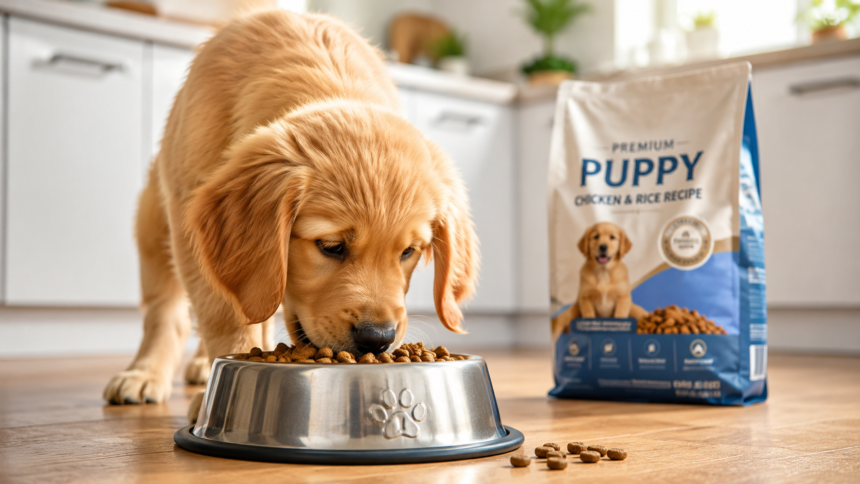
Bringing a puppy home is genuinely one of the best things that can happen to a household. It’s also chaotic, and somewhere between the toilet training and the 3 am cries, you’ll need to figure out what’s actually going in the bowl.
- Why Puppies Can’t Just Eat Adult Dog Food
- How Feeding Needs Shift as Your Puppy Grows
- Actually Reading a Puppy Food Label
- What Actually Makes a Good Puppy Food
- Brands Worth Actually Considering
- What About Supermarket Puppy Food?
- Buying in Bulk: Is a 15kg Bag Worth It?
- Mixing Wet Food With Dry: Does It Actually Help?
- James Wellbeloved: Why It Keeps Coming Up
- Feeding a Labrador Puppy Specifically
- Wet vs Dry: Which One Should You Actually Pick?
- Signs the Food Isn’t Working for Your Puppy
- Mistakes Worth Avoiding
- Feeding Schedules That Actually Work
- What Should You Budget?
- Frequently Asked Questions
- Final Thoughts
This matters more than most new owners expect. Puppyhood only lasts a handful of months, but what happens nutritionally during that window can affect a dog for the rest of its life. Walk into any pet shop or scroll through Amazon and you’ll be hit with dozens of bags all claiming to be the best dry dog food for puppies. Half of them are decent. Some really aren’t.
This guide is meant to save you the guesswork. We’ll get into what actually matters on a label, look at specific UK brands worth considering, talk about wet versus dry, and answer the questions that keep popping up in new owners’ searches. If you’ve just brought a Labrador pup home, or you’re eyeing up a puppy dry food 15kg bag to save yourself a few trips to the shop, there’s something here for you.
Why Puppies Can’t Just Eat Adult Dog Food
Here’s the thing people don’t always think about: a puppy’s body is basically a construction site. Bone, muscle, brain tissue, immune system — all of it is being built at once, and fast. Take a Labrador. Born at under a kilogram, and by their first birthday they might weigh 25kg or more. That’s an enormous amount of growth crammed into twelve months, and it needs fuel that adult dog food simply isn’t designed to provide.
Adult formulas are built to maintain a dog. Puppy food has to build one. Give a puppy an adult diet, and you risk starving their skeleton of the protein and calcium it needs. Go the other way, and a poorly balanced puppy food can push growth along too quickly, which isn’t good for developing joints either.
So when vets keep pushing owners towards food labelled specifically for puppies, this is why. And it’s the starting point for anyone asking what the best dry dog food for puppies really looks like before you even get to ingredients.
How Feeding Needs Shift as Your Puppy Grows
Nutrition isn’t a “set it and forget it” thing with puppies. What works at eight weeks won’t cut it at eight months.
- Weaning (3–8 weeks): Puppies are coming off their mum’s milk. Meals need to be soft and frequent; think little and often.
- Rapid growth (8 weeks to 6 months): This is where most of the skeletal development happens, so protein and calcium needs peak here.
- Slowing down (6–12 months): Growth starts to level off, especially in smaller breeds, and portions usually need to be adjusted to avoid piling on excess weight.
- Near-adult (past 12 months, later for big dogs): Large and giant breeds keep developing well past their first birthday, which is often why vets recommend keeping them on puppy food a bit longer than smaller dogs.
Actually Reading a Puppy Food Label
Honestly, most owners never learn to read these labels properly. It’s not complicated once you know what you’re looking for, though. Ingredients are listed heaviest first. So if a bag opens with chicken, salmon, or turkey, a named animal protein, that’s a good sign. If it opens with cereals or something vague like “meat and animal derivatives,” that’s usually a red flag for cheap filler.
Then there’s the guaranteed analysis: protein, fat, fibre, moisture, all as percentages. Puppies generally need protein around 22–32% and fat around 12–20%. It sounds fiddly, but once you know the range, comparing bags side by side becomes much easier.
Check the life stage statement too. UK law requires food to state which stage it’s meant for, so look for wording like “complete and balanced for growth.” And the feeding chart on the back? Treat it as a rough guide, not gospel. Weigh your puppy now and then and adjust if they’re gaining too fast or not enough.
What Actually Makes a Good Puppy Food
Not every bag with “puppy” printed on the front deserves to be there. A few things genuinely separate the good ones from the rest. Protein comes first. Puppies need noticeably more than adult dogs — usually 22–32%, depending on breed — and where it comes from matters as much as how much there is. Named meats near the top of the ingredients list are what you want to see. DHA is one worth knowing about too. It’s an omega-3, typically derived from fish oil, and there’s solid evidence that it supports brain and eye development in young puppies.
For anyone with a large breed, the calcium-to-phosphorus ratio deserves real attention. Get it wrong, and you risk contributing to joint problems down the line; this is a genuine, well-documented concern in fast-growing large breeds, not just marketing talk. Kibble size matters more than people think as well. A Chihuahua puppy and a young Labrador have completely different mouths, so good manufacturers size the kibble accordingly and often add prebiotics to help a young gut cope.
Brands Worth Actually Considering
A few names come up again and again when you talk to vets or dig through owner reviews, and there’s usually a reason for that.
- Royal Canin Puppy range: built around specific breed sizes, backed by a lot of research into how different dogs actually grow
- James Wellbeloved Puppy food: limited ingredients, hypoallergenic-leaning, a go-to for sensitive pups
- Hill’s Science Plan Puppy: the one vets recommend most often, largely down to its clinical backing
- Eukanuba Puppy: strong focus on bone and joint support
- Wainwright’s Puppy: a decent middle ground if you’re watching the budget
None of these is automatically “the best”; it really comes down to your specific puppy, their breed, and whatever your vet flags at those first check-ups.
What About Supermarket Puppy Food?
Not everyone wants to order online or make a special pet-shop trip, and honestly, there’s nothing wrong with picking up the best supermarket puppy food during your normal shop as long as you know what to look for. Tesco, Sainsbury’s, Asda they all do own-brand and third-party puppy formulas. The quality swings quite a bit though, so don’t assume the supermarket badge means anything either way.
Same rules apply as before: named meat first, not too reliant on cereals, clearly marked as complete and balanced for growth. Some supermarket ranges have actually got a lot better in recent years. Others are still mostly grain and not much else, so it’s worth a quick check before you commit, particularly if you’ve got a large breed at home.
Buying in Bulk: Is a 15kg Bag Worth It?
Once you know your puppy does well on a food, buying bigger bags makes sense financially. A puppy dry food 15kg bag is almost always cheaper per kilo than the smaller ones. Just don’t buy in bulk before you’ve confirmed the food agrees with your puppy. A 15kg bag isn’t the place to run a trial.
Storage matters more than people realise, too. Kibble goes stale once it’s exposed to air and damp, so keep it sealed properly — an airtight container works well — somewhere cool and dry. Worth doing a quick bit of maths as well. A big, hungry Labrador will demolish 15kg far quicker than a small terrier puppy on modest portions, and food does start losing nutritional value once opened for a while (roughly six weeks is the usual guideline).
Mixing Wet Food With Dry: Does It Actually Help?
Loads of UK owners don’t feed dry exclusively, and finding the best wet puppy food to mix with dry can genuinely make mealtimes easier, especially for fussier eaters. Wet food tends to smell stronger and taste better to a young puppy still figuring out solid food. It’s also higher in moisture, which helps with hydration — genuinely useful for kidney and bladder health early on.
It’s a handy tool during a fussy phase too, which basically every puppy owner runs into at some point. If you’re pairing wet with dry, stick to the same brand where possible. Royal Canin, James Wellbeloved, Hill’s — they all do wet ranges built to complement their dry food. Something like 75% dry to 25% wet by weight is a common starting ratio, though your vet can fine-tune that based on your puppy’s actual calorie needs.
James Wellbeloved: Why It Keeps Coming Up
James Wellbeloved Puppy food gets searched constantly, and it’s usually the sensitive-stomach crowd looking for it. The whole approach is built around a single named protein — turkey or lamb, typically — paired with rice instead of wheat. That simplicity is exactly what makes it work for puppies who react to more common ingredients. The brand’s been doing this since the early 90s, which counts for something. It’s not cheap, sitting mid-to-premium on price, but for a puppy showing signs of sensitivity, it’s consistently one of the first brands vets and owners alike suggest trying.
Feeding a Labrador Puppy Specifically
Labradors are everywhere in the UK, and they come with a very specific challenge: they grow fast, they’re prone to putting on weight as adults, and most of them would eat literally anything you put in front of them.
Finding the best puppy food Labrador owners can trust means thinking about controlled growth just as much as satisfying that appetite. Because Labs carry a real risk of hip and elbow dysplasia, large-breed-specific formulas tend to be the smarter call over standard puppy food; they manage calcium and phosphorus more carefully.
Royal Canin’s Labrador-specific formula, Eukanuba Large Breed Puppy, and Hill’s Large Breed Puppy all come up regularly in vet recommendations. And honestly, portion control matters just as much as the food itself. Here, measuring meals properly, rather than letting a Lab free-feed, makes a real difference.
Wet vs Dry: Which One Should You Actually Pick?
Neither wins outright; it really depends on what you and your puppy need. Dry food is convenient, keeps well once opened, and the chewing action helps a bit with dental health. It’s also cheaper calorie-for-calorie. Wet food has more moisture and is usually more appealing, particularly when a puppy’s teething or still adjusting off milk.
Most owners end up doing both dry as the everyday base, wet mixed in for taste and hydration. Vets rarely insist on strictly one or the other unless there’s a specific medical reason behind it.
Signs the Food Isn’t Working for Your Puppy
Not every recipe suits every dog, even a good one. Keep an eye out for:
- Loose stools, diarrhoea, or a lot of gas that doesn’t settle after a full transition
- Itchy skin, constant paw-licking, or ear infections that keep coming back
- A coat that looks dull or flaky despite regular brushing
- Suddenly going off food they used to enjoy
- Vomiting that isn’t just down to eating too fast
Seeing two or more of these fairly consistently? Worth a vet visit before you switch food again.
Mistakes Worth Avoiding
A few things trip owners up over and over:
- Accidentally buying adult food, or staying on puppy food long past when it should’ve switched
- Changing food overnight instead of transitioning over a week or two
- Guessing portions instead of following weight-based guidelines
- Ignoring breed size — a large or giant breed really shouldn’t be on a standard formula
- Buying a puppy dry food 15kg bag before knowing if the puppy even likes or tolerates it
Feeding Schedules That Actually Work
How you feed matters nearly as much as what you feed. Puppies need smaller, more frequent meals than adult dogs simply because their stomachs are tiny relative to their energy needs.
Roughly: four meals a day between 8–12 weeks, dropping to three by around four months, then two from six months onward. It’s a guideline, not a rulebook — your vet might tweak it depending on breed and appetite.
Whenever you do switch foods, go slow. Over 7–10 days, mix in a bit more new food each day, starting around 25% new to 75% old. Rushing this is the single most common cause of an upset tummy in a newly adopted puppy.
What Should You Budget?
Costs vary a fair bit. Budget supermarket options run around £1–£2 per kilo, while premium names like Royal Canin or Hill’s sit closer to £3–£6. A medium breed on a mid-range food might cost you £15–£25 a month. Bigger dogs going through a puppy dry food 15kg bag every few weeks are looking at more like £30–£50. Adding wet food into the mix nudges that up a bit further, but for a fussy eater, it’s usually worth it.
Frequently Asked Questions
What is the best dry food for a puppy?
Depends entirely on breed size and any sensitivities, honestly. Royal Canin, James Wellbeloved, and Hill’s Science Plan are the names that come up most consistently among UK owners and vets.
What is the number one vet-recommended dog food for puppies?
No single brand dominates every recommendation, but Hill’s Science Plan and Royal Canin get mentioned most often in UK practices.
What is the healthiest food to feed a puppy?
Look for a complete, growth-appropriate food with a named protein at the top and DHA included. Skip anything padded out mostly with cereals.
What are the top five best dry dog food brands for puppies?
Royal Canin, Hill’s Science Plan, James Wellbeloved, Eukanuba, and Wainwright’s are all solid starting points.
What is considered the healthiest dry dog food?
One with a clean, traceable ingredient list, real named protein, minimal artificial extras, and nutrition matched properly to life stage.
Can a 2-month-old puppy eat dry kibble?
Yes, though it often helps to soften it with a bit of warm water at first while their jaw’s still developing.
Can 5-week-old puppies go all night without eating?
Not really — at this age they’re still coming off milk and need frequent small feeds rather than long gaps.
Can I give a boiled egg to my 2-month-old puppy?
A small bit of plain, well-cooked egg is generally fine as an occasional extra, but it shouldn’t replace their actual food.
Is it better to give puppies wet or dry food?
Neither wins outright — a mix of both usually covers the most bases in terms of dental health, cost, and palatability.
Can a 1-month-old puppy eat rice?
Not yet — at one month, they should still be on milk or a replacer. Small amounts of well-cooked rice usually come in from around three to four weeks, introduced slowly.
Final Thoughts
Getting puppy nutrition right doesn’t have to be complicated. Focus on the basics: life stage, protein quality, breed-appropriate formulation, and a sensible feeding routine, and you’re most of the way there.
Whether you go with a specialist brand, a decent supermarket option, or a mix of wet and dry, the aim is the same: giving your puppy a solid foundation for a long, healthy life. If you’re ever unsure, your vet is still your best resource for fine-tuning any of this to your specific dog.