

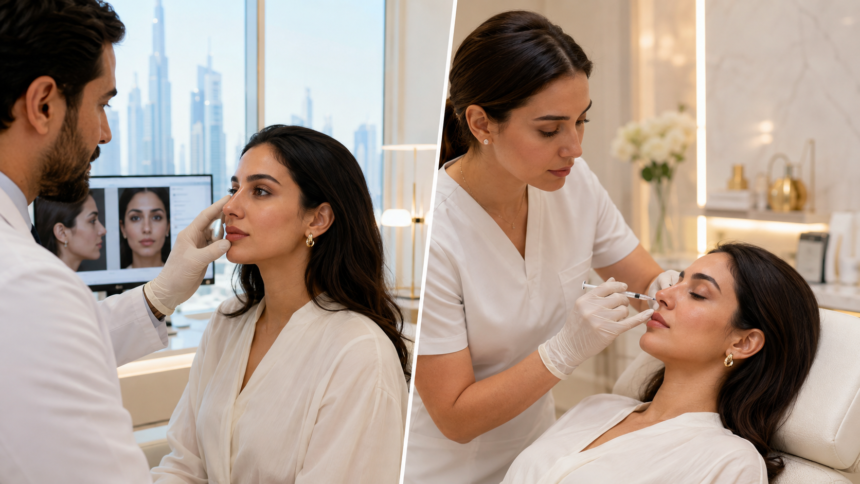
Stand in front of any mirror long enough, and most of us can point to something on our nose we’d tweak. Maybe it’s a bump you’ve noticed since your teens, or a tip that never quite sat straight after an old injury. In Dubai, you’ve got two very different ways to deal with it: go under the knife, or book a 20-minute appointment with a syringe. Neither is automatically the “better” choice. It depends entirely on what you’re actually trying to fix.
- What Rhinoplasty Actually Involves
- What Nose Fillers Actually Do
- Rhinoplasty in Dubai: What It Costs and What Recovery Looks Like
- Nose Fillers in Dubai: What It Costs and What to Expect
- Side by Side: The Real Differences Between Rhinoplasty vs. Non-Surgical Nose
- So, Which One Fits You?
- Can You Actually Do Both? Rhinoplasty vs. Non-Surgical Nose
- Questions Worth Asking at Your Consultation
- Picking the Right Clinic in Dubai
- FAQs About Rhinoplasty vs. Non-Surgical Nose
- Final Thoughts on Rhinoplasty vs. Non-Surgical Nose
What Rhinoplasty Actually Involves
Rhinoplasty reshapes the nose by working directly on bone and cartilage — sometimes skin too, depending on the case. Surgeons in Dubai perform it for cosmetic reasons, sure, but also to fix breathing problems or repair damage from an old injury.
The surgery itself takes one to three hours, done under general anesthesia. Some surgeons work through hidden incisions inside the nostrils. Others need to open things up slightly across the small strip of skin between them, especially for more complex reshaping. Either way, once it’s done, it’s done. The change is permanent, which is exactly why so many patients still choose surgery even with quicker alternatives sitting right next door.
When Surgery Is Really the Only Option
Fillers can hide a lot, but they can’t rebuild bone. If you’re dealing with any of the following, rhinoplasty is genuinely your only route forward:
- A visible hump or noticeable crookedness along the bridge
- A deviated septum making it hard to breathe properly
- Damage from an old accident or sports injury
- A tip that’s too wide, droopy, or bulbous for your face
- A nasal defect you’ve had since birth
If your issue lies in the structure itself, no amount of changes to injectable products will fix it.
What Nose Fillers Actually Do
People call this the “liquid nose job,” and honestly, the nickname fits. A practitioner injects hyaluronic acid filler into specific spots to smooth a bump, lift a drooping tip, or even out asymmetry all without touching bone or cartilage.
The whole thing takes 15 to 30 minutes, start to finish—no anesthesia beyond a numbing cream, no time off work. Most people book it on a lunch break and go straight back to their desk.
What fillers can’t do is remove anything. They work by adding volume in the right places to visually balance out the parts that bother you. It’s an illusion, essentially — a well-done one, but an illusion nonetheless.
Who Gets the Most Out of Fillers
This treatment shines for smaller, cosmetic concerns rather than anything structural. It tends to suit people who want to:
- Smooth over a minor bump or dip on the bridge
- Straighten out a slightly off-center tip
- Balance the overall profile without committing to surgery
- Try out a different nose shape before deciding on something permanent
- Skip the downtime and cost that come with an operation
Just don’t expect fillers to fix a breathing issue or reshape something that’s genuinely structural. That’s not what they’re built for.
Rhinoplasty in Dubai: What It Costs and What Recovery Looks Like
Dubai has quietly become one of the region’s biggest destinations for cosmetic surgery, and rhinoplasty is a big part of that. Patients fly in from across the Gulf specifically for it. If you’re weighing this option seriously, here’s what the process tends to look like.
The Cost Breakdown
Expect to pay somewhere between AED 15,000 and AED 35,000, depending on your surgeon’s experience, the clinic itself, and how complex your case is. Revision rhinoplasty — fixing a previous surgery — usually runs higher because it’s technically harder to get right.
A lot of clinics offer payment plans, which helps. Just make sure you ask what’s actually included in your quote. Anesthesia, follow-ups, and post-op garments sometimes show up as separate line items, and nobody wants that surprise after the fact.
How Recovery Actually Unfolds
Recovery isn’t linear, and it takes longer than most people expect going in.
- Week 1: Swelling and bruising hit their peak. You’ll likely wear a splint to protect the new shape.
- Weeks 2 to 4: Bruising fades noticeably, and you can usually get back to light work and seeing people.
- Months 2 through 6: Swelling keeps quietly reducing, and the nose starts revealing its actual final shape.
- Up to a year: Everything settles fully, especially around the tip, which takes the longest to finish healing.
Most surgeons in Dubai will tell you to avoid intense workouts, direct sun, and even resting glasses on your nose bridge for at least six weeks.
The Risks Worth Knowing About
Any surgery carries risks: infection, scarring, breathing complications, or just not loving the final result. A board-certified surgeon with a solid track record cuts down on all of that significantly. Before you commit to anyone, check their credentials through the Dubai Health Authority. It takes five minutes, and it matters.
Nose Fillers in Dubai: What It Costs and What to Expect
If surgery feels like too big a leap right now, fillers give you a much lower-stakes way to test the waters, and they’ve become genuinely popular across Dubai’s clinics for exactly that reason.
The Cost Breakdown
A session typically runs AED 1,500 to AED 3,500, depending on how much filler your case needs and who’s doing the injecting. Since results fade over time, most patients budget for a touch-up every 12 to 18 months rather than treating it as a one-time expense.
How Long the Results Actually Last
Hyaluronic acid filler generally holds for 12 to 18 months before your body naturally breaks it down. Some people notice it fading a bit sooner, particularly if they have a faster metabolism.
Recovery Time (Or the Lack of It)
This is really where fillers win people over. Mild swelling or redness at the injection site usually clears within a day or two. Bruising is possible but not that common, and it depends a lot on individual skin sensitivity.
Practitioners typically recommend skipping intense exercise, saunas, and sleeping face-down for the first 24 hours, just to let everything settle properly.
The Risks You Shouldn’t Ignore
Vascular complications are rare with nose fillers, but they’re serious when they happen — usually caused by filler getting injected too close to a blood vessel. This is precisely why injector experience matters so much here. Don’t just check that someone does fillers generally; confirm they specifically have documented experience with nasal filler work.
Side by Side: The Real Differences Between Rhinoplasty vs. Non-Surgical Nose
Both treatments change how your nose looks, but they work in completely different ways. Here’s the comparison that actually matters when you’re deciding.
| Factor | Rhinoplasty | Non-Surgical Fillers |
| Permanence | Permanent | Lasts 12–18 months |
| Downtime | 2–4 weeks | Barely any |
| Cost | AED 15,000–35,000 | AED 1,500–3,500 |
| Fixes breathing issues | Yes | No |
| Anesthesia | General | Numbing cream only |
| Reversibility | No | Can be dissolved |
So, Which One Fits You?
This really comes down to three questions: what exactly do you want fixed, how long do you want it to last, and how much time can you realistically take off?
If You Need Surgery
If breathing is part of the problem, or there’s a real structural issue like a deviated septum or a significant hump, fillers simply won’t get you there. Surgery becomes the practical answer because it deals with what’s actually causing the problem — not just what’s visible on the surface.
If Fillers Make More Sense
For smaller cosmetic tweaks — a subtle dip, slight asymmetry, that kind of thing — fillers often do the job without asking for weeks of recovery or a big financial commitment upfront. A lot of first-timers also use fillers just to preview what a straighter nose might look like before deciding whether surgery is worth pursuing later.
Where Budget Fits Into This
Money matters here too, and it’s fine to admit that. Fillers let you spread cost across smaller sessions instead of one large payment. Surgery costs more at the start, but you’re not paying for touch-ups every year either.
Can You Actually Do Both? Rhinoplasty vs. Non-Surgical Nose
Some patients don’t realize these two treatments aren’t mutually exclusive — they can actually work together at different points.
Using Fillers as a Trial Run
Because filler results aren’t permanent, plenty of people use them first just to see how a different nose shape feels before committing to something you can’t undo.
Using Fillers After Surgery for Small Fixes
Once a nose fully heals post-rhinoplasty, some patients notice tiny asymmetries that settled slightly differently than planned. A small amount of filler can often smooth that out without needing a full revision surgery.
Why This Approach Works Well for Cautious Patients
If you like the idea of permanent results eventually, but aren’t ready to jump straight into surgery, this staged approach lets you build confidence first. You get to test the look, adjust your expectations, and move toward rhinoplasty on your own timeline.
Questions Worth Asking at Your Consultation
Whichever direction you’re leaning, walk into your consultation prepared. Ask:
- What’s realistic for my nose specifically, given its current shape?
- How many procedures like mine have you personally done?
- What’s the plan if I’m not happy with how it turns out?
- Does anything in my medical history affect my options here?
- What’s actually included in this price, and is anything billed separately?
A good practitioner answers all of this clearly, without rushing you toward a decision on the spot.
Picking the Right Clinic in Dubai
Dubai isn’t short on cosmetic clinics — that’s part of the problem. Before booking either treatment, confirm the clinic is licensed through the Dubai Health Authority and that whoever’s treating you holds real, relevant certification.
Ask to see before-and-after photos of actual patients, not stock images pulled off a supplier’s website. Read reviews from outside sources too, not just testimonials the clinic hand-picked for its own page. A consultation that feels rushed, or vague about risks, or overly focused on upselling — that’s a sign to walk and get a second opinion elsewhere.
Trust how the conversation feels, honestly. Good practitioners want you informed. The ones worth avoiding usually reveal themselves pretty quickly.
FAQs About Rhinoplasty vs. Non-Surgical Nose
Is non-surgical rhinoplasty as effective as surgical rhinoplasty in Dubai?
It depends on what you’re fixing. Non-surgical rhinoplasty handles minor cosmetic issues well, like small bumps or slight asymmetry, but it can’t touch structural problems or breathing difficulties the way surgery can.
How much does rhinoplasty cost in Dubai compared to nose fillers?
Rhinoplasty generally runs AED 15,000 to AED 35,000, while nose filler sessions cost between AED 1,500 and AED 3,500 — a much smaller upfront commitment, though it’s not permanent.
Can nose fillers fix a crooked nose permanently?
Not permanently, no. Fillers can visually camouflage minor irregularities for a while, but a crooked nose caused by underlying bone or cartilage issues really needs surgery for a lasting fix.
How painful is rhinoplasty recovery in Dubai clinics?
Most patients describe it as more uncomfortable than outright painful, and prescribed medication handles it fine. Swelling and bruising tend to bother people more than actual pain during recovery.
Do non-surgical nose fillers require any downtime?
Barely any. Most people go straight back to their normal routine the same day, maybe with some mild swelling that clears up within 24 to 48 hours.
Final Thoughts on Rhinoplasty vs. Non-Surgical Nose
Rhinoplasty and non-surgical fillers solve different problems, even though they both change how your nose looks. Surgery gives you permanent, structural change and makes sense when there’s a genuine physical issue involved. Fillers give you flexibility, lower cost, minimal downtime, and a way to test changes before deciding whether you want them for good.
Think honestly about what’s actually bothering you, how long you want the fix to last, and how much time you can give to recovery. Then find a licensed, experienced professional and have a real conversation about which path fits your face and your life best.