

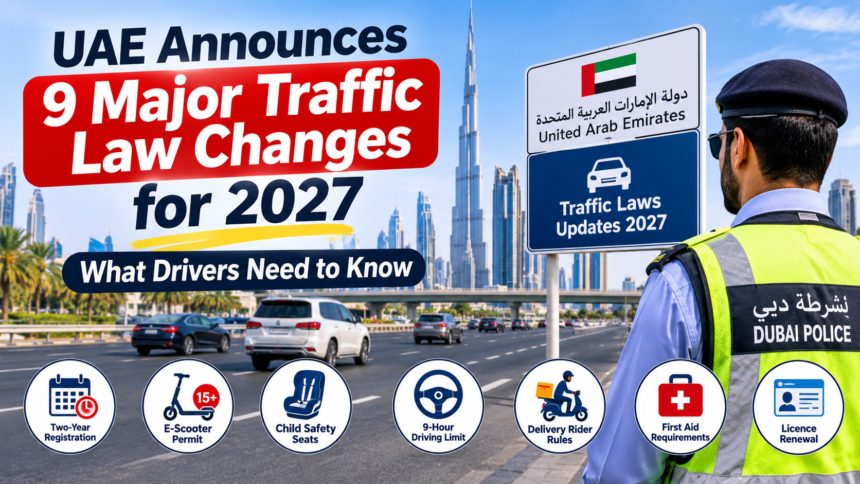
The UAE is preparing to introduce significant traffic regulation changes from 1 January 2027, affecting private motorists, professional drivers, delivery riders, vehicle owners, and electric scooter users. These updates are designed to strengthen road safety, improve vehicle regulation and establish clearer responsibilities for people using the country’s transport network. Understanding the UAE traffic law changes in 2027 is particularly important for residents, expatriates, and tourists who drive regularly or plan to use personal mobility devices. The new requirements also address child passenger protection, driving hours, and vehicle registration. In this guide, we explain the UAE traffic law changes for 2027, distinguish confirmed provisions from postponed measures, and highlight what motorists should do to prepare. For more updates, explore the Dubai PR Submission Blog.
- Overview of the UAE’s 2027 Traffic Law Updates
- First Confirmed Traffic Law Change: Optional Two-Year Vehicle Registration
- Second Confirmed Traffic Law Change: Minimum Age for Electric Scooter Permits
- Third Confirmed Traffic Law Change: New Technical Requirements for E-Scooters and E-Bikes
- Fourth Confirmed Traffic Law Change: Stronger Child Passenger Safety Requirements
- Fifth Confirmed Traffic Law Change: Nine-Hour Driving Limit Within 24 Hours
- Sixth Confirmed Traffic Law Change: Additional Responsibilities for Delivery Drivers
- What Delivery Companies Need to Do
- How Delivery Riders May Be Affected
- Seventh Confirmed Traffic Law Change: New Conditions for Providing First Aid After Accidents
- Eighth Confirmed Traffic Law Change: Additional Restrictions on Right-Hand-Drive Vehicles
- Ninth Confirmed Traffic Law Change: Driving Licence Renewal After Ten Years of Expiry
- How the New Regulations May Affect UAE Drivers
- Traffic Fines, Penalties and Enforcement
- How Motorists Can Stay Compliant with UAE Driving Rules
- Frequently Asked Questions (FAQs)
- Conclusion
Overview of the UAE’s 2027 Traffic Law Updates
The new framework comes under Cabinet Decision No. 174 of 2026, which implements Federal Decree-Law No. 14 of 2024 on Traffic Regulation. The federal decree-law became effective on 29 March 2025, while the new implementing regulations are scheduled to apply from 1 January 2027.
The Emirates News Agency (WAM) confirmed the implementation date and outlined provisions covering vehicle registration, personal mobility devices, child safety, driving hours and professional transport services. These are federal regulations, although local licensing authorities retain responsibilities for implementation and certain operational requirements.
The most important points motorists should understand include:
- Vehicle registration: An optional two-year registration period for qualifying light vehicles.
- Personal mobility: New permit requirements and a minimum age of 15 for specified electric mobility devices.
- Child protection: Mandatory appropriate safety seats for children aged four and under.
- Driving hours: A maximum of nine hours of driving within 24 hours.
- Delivery services: Additional professional requirements for motorcycle delivery riders.
- Driving licences: Additional testing requirements for licences that have remained expired for more than ten years.
- First aid: Conditions governing who may administer first aid at accident scenes.
One widely reported measure requires special clarification. The proposed limit of five registered vehicles per resident, with additional fees beyond two vehicles, was postponed by the Ministry of Interior on 9 November 2026 pending further review. It should therefore not be presented as a confirmed January 2027 implementation measure.
First Confirmed Traffic Law Change: Optional Two-Year Vehicle Registration
Article 98 introduces an option allowing eligible light vehicle owners to request a registration validity period of two years instead of the standard one-year period.
This provision is particularly useful for motorists who prefer fewer administrative renewal procedures. However, the longer registration period is not automatic. Approval remains subject to the relevant licensing authority.
The vehicle must satisfy the following conditions:
- It must have been brand new when initially registered.
- It must be no more than six years old from its manufacturing date.
- It must be owned by an individual rather than a company or other legal entity.
For example, an individual purchasing an eligible new car may request two-year registration, provided the licensing authority approves the application.
Motorists should continue checking their vehicle’s insurance, inspection and registration requirements rather than assuming that a longer registration period removes other legal obligations.
Second Confirmed Traffic Law Change: Minimum Age for Electric Scooter Permits
The UAE is introducing a more structured regulatory framework for personal mobility devices, including electric bicycles, electric scooters and small-wheeled motorised cycles.
Under Article 59, applicants must be at least 15 years old to obtain the relevant permit. The permit will remain valid for three years.
The regulation also establishes different categories of personal mobility devices, including conventional bicycles, electric bicycles, electric scooters, skateboards and mobility equipment designed for elderly people and individuals with disabilities.
This development is particularly relevant to teenagers, parents, commuters and residents who use electric scooters for short journeys.
Importantly, obtaining a permit does not mean riders can use these devices anywhere. They must follow the routes and roads designated by the relevant licensing or traffic control authority in their emirate.
Dubai residents should also check local requirements before riding, because emirate-specific restrictions may impose additional conditions.
Third Confirmed Traffic Law Change: New Technical Requirements for E-Scooters and E-Bikes
The new regulations introduce specific equipment and maintenance requirements for personal mobility devices.
Article 4 focuses on visibility, braking performance, and the general roadworthiness of these vehicles. These measures aim to reduce accidents involving electric scooters and bicycles, particularly in areas shared with pedestrians and motor vehicles.
The required safety features include:
- A front light for illuminating the road at night.
- A rear light and red brake light.
- An audible warning device fitted to the handlebars.
- At least one brake fitted to the rear wheel.
- Properly fitted and roadworthy tyres.
- Complete, correctly tensioned wheel spokes.
- Components maintained in safe working condition.
Riders should inspect their equipment regularly and replace damaged components before using their devices on public routes.
The relevant licensing authority may also establish additional technical conditions. Consequently, riders should check local requirements rather than assuming that meeting the federal minimum standards is sufficient.
Fourth Confirmed Traffic Law Change: Stronger Child Passenger Safety Requirements
Child passenger protection is another important part of the new UAE road safety regulations.
Article 11 requires drivers to provide appropriate child safety seats for children aged four and under. These seats must correspond to the child’s height and weight, comply with applicable national standards, and be installed in the rear seats.
The regulation also recognises limited exceptions.
Where a child’s medical condition prevents the use of a protective seat, an official medical certificate is required, and an attendant must accompany the child in the rear seat.
For vehicles with rear seats, a child safety seat may be installed in the front, provided it faces backwards, and the airbag is deactivated.
This requirement is especially important for parents, school transport arrangements and families travelling with young children.
Drivers should check that their child seats are correctly installed before travelling. Holding a valid driving licence does not remove the responsibility to ensure that young passengers are properly protected.
Fifth Confirmed Traffic Law Change: Nine-Hour Driving Limit Within 24 Hours
One of the most significant provisions concerns driver fatigue. Article 7 establishes a maximum driving period of nine hours within any 24 hours. It also prohibits driving when fatigue or exhaustion affects a person’s ability to operate a vehicle safely.
The Federal Traffic Council has authority to adjust the prescribed driving limit. This requirement is particularly relevant to professional drivers, delivery workers, transport operators and people who regularly undertake long-distance journeys.
For example, a driver who spends several hours behind the wheel during the morning and afternoon must account for the total driving time within the relevant 24-hour period.
The provision is designed to address fatigue-related road risks and encourage safer driving practices. Motorists should not assume that reaching the nine-hour limit is the only reason to stop. Anyone who feels too tired to drive safely should take an appropriate break.
The practical application of the provision, including monitoring and enforcement arrangements, should be confirmed through the relevant authorities.
Sixth Confirmed Traffic Law Change: Additional Responsibilities for Delivery Drivers
The UAE is also strengthening the regulatory framework governing motorcycle delivery services.
Article 10 introduces specific responsibilities for delivery drivers to improve operational safety and establish clearer professional standards.
These requirements are especially relevant to food delivery companies, courier businesses, logistics operators, and motorcycle riders working through delivery platforms.
Delivery drivers must:
- Wear the prescribed professional uniform.
- Carry a valid professional permit and present it when requested.
- Use approved systems installed in their vehicles.
- Avoid carrying a passenger behind them on a motorcycle while performing delivery duties.
- Avoid using backpacks to transport delivery orders.
- Use designated and approved delivery equipment.
What Delivery Companies Need to Do
Companies operating delivery fleets should review their existing procedures before the regulations take effect.
They should check that riders have the necessary permits, approved equipment, and appropriate uniforms. Employers should also ensure that delivery motorcycles comply with relevant safety standards.
How Delivery Riders May Be Affected
Individual riders may need to change their equipment or working practices to meet the updated requirements.
For example, a rider who currently carries food orders in a personal backpack may need to switch to an approved delivery system.
Companies should communicate these requirements clearly to employees and independent delivery partners to reduce the risk of non-compliance.
Seventh Confirmed Traffic Law Change: New Conditions for Providing First Aid After Accidents
The new implementing regulations also address assistance provided to people injured in road accidents. Under Article 13, individuals may administer first aid to traffic accident victims if they hold an accredited certificate confirming successful completion of an approved first aid training course. Where the certificate has an expiry date, it must remain valid. The person assisting must also have the physical capacity necessary to respond appropriately to the injured person’s condition.
This provision is relevant to motorists, professional drivers, transport workers and individuals who may encounter road accidents during their daily journeys. It establishes a clearer framework for qualified assistance while recognising that first aid requires appropriate training and capability. Drivers should still contact the emergency services when an accident occurs and avoid attempting medical procedures beyond their training.
Eighth Confirmed Traffic Law Change: Additional Restrictions on Right-Hand-Drive Vehicles
The implementing regulations also address the licensing of right-hand-drive vehicles. Article 89, as described in the WAM announcement, prohibits licensing right-hand-drive vehicles for ordinary road use, allowing them only for exhibition purposes. This provision is relevant to vehicle collectors, importers, specialist car businesses and individuals considering bringing right-hand-drive vehicles into the UAE.
A vehicle’s ownership or successful importation should not be treated as automatic permission to register and operate it on public roads. Interested owners should confirm the applicable vehicle classification and licensing requirements with the relevant authority before purchasing or importing such a vehicle. The separate postponement of the proposed five-vehicle-per-resident limit should not be confused with this right-hand-drive restriction. The Ministry’s announcement specifically concerned the numerical registration limit, which is under review.
Ninth Confirmed Traffic Law Change: Driving Licence Renewal After Ten Years of Expiry
The updated regulations introduce an additional requirement for drivers whose licences have remained expired for more than ten years.
Under Article 76, applicants in this situation must complete the theoretical and practical assessments determined by the relevant licensing authority before renewing their licences. The ten years is calculated from the licence’s expiry date, not its original issue date. This requirement is important for expatriates returning to the UAE, former residents, motorists who have stopped driving, and people who have allowed their licences to remain expired for extended periods.
For example, someone whose UAE driving licence expired more than ten years ago should not assume that paying the renewal fee will be sufficient. They may need to undergo the required assessments. The relevant authority determines the testing arrangements and any additional procedures. Drivers should also ensure that outstanding traffic fines and other renewal requirements have been addressed.
How the New Regulations May Affect UAE Drivers
The new framework will affect different groups of road users in different ways. Private motorists may benefit from the optional two-year vehicle registration arrangement, while families will need to pay closer attention to child passenger safety requirements.
The UAE traffic law changes in 2027 also introduce practical responsibilities for people using electric scooters, motorcycles, and delivery vehicles. These requirements extend beyond conventional driving and reflect the growing use of alternative transport options.
The main groups likely to notice changes include:
- Private vehicle owners: Eligible owners can request longer registration validity, while those with right-hand-drive vehicles should review licensing restrictions.
- Parents and families: Appropriate child safety seats will be required for children aged four and under, subject to the specified exceptions.
- Professional drivers: The nine-hour driving limit will require attention to working schedules and fatigue management.
- Delivery companies: Businesses will need to review rider permits, uniforms, passenger restrictions and approved delivery equipment.
- Electric scooter users: Riders will need to understand permit eligibility, designated routes and equipment standards.
- Expatriates and returning residents: People renewing long-expired driving licences may need to complete additional assessments.
Dubai motorists should also remember that federal regulations operate alongside local traffic instructions. For example, Dubai Police and the RTA may issue emirate-specific operational requirements. Understanding how Dubai’s AI traffic radars detect violations can help motorists appreciate the importance of following road rules consistently.
Traffic Fines, Penalties and Enforcement
A common concern among motorists is whether the new regulations will introduce higher traffic fines in 2027. It is important to distinguish between a new regulatory obligation and a newly announced financial penalty. The WAM announcement outlining the major implementing provisions does not provide a new fine schedule covering all nine areas discussed above. Therefore, drivers should not assume that every new requirement automatically carries a specific additional fine or that existing penalties have increased.
The UAE traffic law changes in 2027 should be understood alongside the existing federal traffic penalty framework and applicable local enforcement decisions. Enforcement may involve inspections, licensing checks, and traffic monitoring, depending on the particular requirement.
Understanding Existing Traffic Enforcement
Motorists should continue checking official channels for recorded violations, payment requirements, and updates to enforcement procedures.
Dubai drivers can consult the relevant Dubai Police traffic rules and violation information and use official government services to review their records.
The Dubai smart parking camera developments also illustrate how technology supports parking monitoring and compliance. However, parking enforcement developments should not be mistaken for new federal traffic fines.
Do the New Rules Automatically Increase Traffic Fines?
No blanket increase in traffic fines has been established by the WAM announcement of Cabinet Decision No. 174 of 2026.
Drivers should refer to the official UAE road safety and traffic information for applicable rules and authorised fine-payment channels.
Emirates News Agency+1
How Motorists Can Stay Compliant with UAE Driving Rules
Preparation is the best way to avoid unnecessary complications when the new regulations take effect.
Motorists should review their vehicle documents, understand their responsibilities, and follow announcements from their emirate’s licensing and traffic authorities.
The following practical steps can help drivers prepare for the UAE traffic law changes in 2027:
- Check your vehicle registration expiry date and confirm whether your vehicle qualifies for two-year registration.
- Review the relevant licensing requirements before purchasing or importing a vehicle.
- Ensure children aged four and under travel in appropriate, correctly installed safety seats.
- Check electric scooter permits, age eligibility and approved riding routes.
- Inspect electric mobility equipment, including lights, brakes and tyres.
- Delivery companies should verify professional permits and approved equipment.
- Avoid driving when tired and plan suitable breaks during longer journeys.
- Check outstanding traffic fines before renewing your driving licence.
- Confirm whether an expired driving licence requires theory and practical assessments.
- Follow official traffic announcements and local road signs.
Motorists can also benefit from understanding everyday road procedures. For example, Dubai’s car parking system and the guide to paying for parking in Dubai can help residents and visitors avoid common parking mistakes.
Tourists planning to drive should review practical road safety tips for exploring Dubai, particularly when unfamiliar with local roads, parking arrangements, and traffic signs.
Staying informed is not only about avoiding fines. It also helps drivers protect passengers, pedestrians, and other road users.
Frequently Asked Questions (FAQs)
1. What are the new UAE traffic laws for 2027?
The new regulations introduce an optional two-year registration period for eligible light vehicles, electric mobility permits, child safety seat requirements, a nine-hour driving limit, delivery rider obligations, first aid conditions and additional licence renewal assessments. Right-hand-drive vehicle licensing restrictions are also addressed. The proposed five-vehicle registration cap has been postponed.
2. When will the new UAE traffic regulations take effect?
Cabinet Decision No. 174 of 2026 is scheduled to take effect on 1 January 2027. The Ministry of Interior has separately postponed the proposed vehicle registration limit pending further review.
3. Will traffic fines increase in the UAE in 2027?
There is no blanket increase in traffic fines established by the published WAM announcement. Motorists should check the applicable federal and emirate-level penalty schedules rather than relying on unverified reports.
4. Do the new traffic rules apply to all UAE emirates?
The implementing regulations establish a federal framework for the UAE. However, local authorities retain responsibilities for licensing, designated mobility routes, and certain operational requirements. Drivers should check the relevant emirate’s instructions.
5. What should motorists do to avoid UAE traffic fines?
Keep vehicle registration and insurance valid, follow speed limits, use appropriate child seats, obey parking restrictions, and maintain roadworthy vehicles. Drivers should also check official traffic updates and pay outstanding fines when required.
Conclusion
The UAE’s upcoming traffic regulations represent an important step towards safer roads, clearer vehicle licensing procedures and better oversight of modern transport services. From child passenger protection and electric scooter permits to professional driving responsibilities, the new requirements will affect several categories of road users. Understanding the UAE traffic law changes in 2027 will help residents, tourists, expatriates and businesses prepare for the January implementation date. Motorists should rely on official government announcements rather than rumours about fines or postponed provisions. Regularly checking Ministry of Interior, RTA, and Dubai Police updates is the best way to remain informed, compliant, and responsible on UAE roads.